
How to Write Slow Burn Romance That Readers Can’t Put Down
A slow burn romance is a love story that deliberately takes its time — feelings simmer for hundreds of pages before the characters admit them. Whether you outline by hand or lean on an ai romance writing assistant to test scenes, the craft is the same: build tension readers ache to see resolved. Romance itself is a broad, well-documented genre — Wikipedia’s overview of the romance novel is a useful starting map before you narrow into a single subgenre.
This guide walks through the seven building blocks of a great slow burn — chemistry, believable obstacles, near-miss beats, subtext, pacing, tasteful intimacy, and the payoff — with examples from beloved novels. Short, actionable, and SFW.

What «Slow Burn» Actually Means (and How It Differs From Insta-Love)
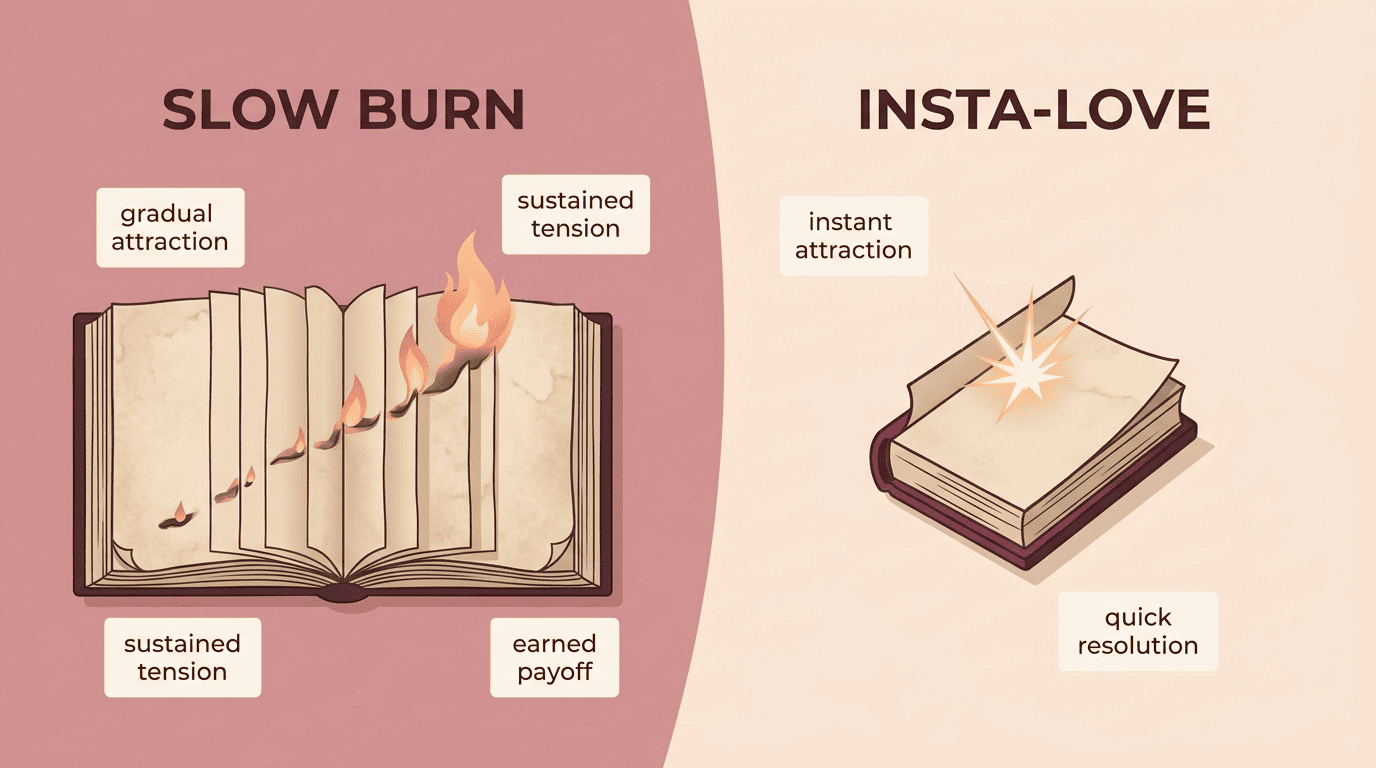
A slow burn is defined by gradual, organic development of feelings and sustained tension between two characters — it simmers for hundreds of pages or episodes rather than resolving in a single scene. Insta-love, by contrast, is the trope where attraction is instant and mutual, often settled within a chapter or two. Neither approach is wrong on its own; they simply trade different things for different rewards, and understanding the trade is the first step toward choosing one on purpose.
Slow burn vs. insta-love
A slow burn is defined by gradual, organic development of feelings and sustained tension — it «simmers for hundreds of pages or episodes.» Insta-love resolves attraction in a chapter. The trade-off is real: slow burn buys deeper reader investment, but it demands far more craft to sustain — every scene has to earn its place, or the middle sags.
| Slow burn | Insta-love | |
|---|---|---|
| Pace of attraction | Gradual, spread across the book | Immediate, within a scene or two |
| Reader payoff | Delayed, high-stakes catharsis | Quick emotional resolution |
| Craft demands | Sustained tension, pacing discipline | Strong chemistry writing upfront |
| Best fit | Character-driven, longer works | Shorter romances, novellas |
Why readers love the wait
Delayed gratification is the engine here. The pleasure isn’t in the kiss itself — it’s in the anticipation that precedes it: charged silences, a held glance, the will-they-won’t-they ache readers keep turning pages to resolve. The longer the wait is earned rather than stalled, the bigger the emotional release when it finally lands.
Start With Chemistry and Pining
Chemistry is not lust at first sight — it’s a spark of connection that grows as two characters challenge and complement each other. Readers should feel the pull building through dialogue and shared moments long before either character names it out loud. It helps to distinguish this from simple attraction: Merriam-Webster defines «pining» around the idea of feeling sad because you want something, or someone, you don’t yet have — precisely the ache a slow burn is built to sustain.
Build a spark, not instant attraction
Show chemistry through banter, shared values, and complementary wounds rather than a single dramatic meet-cute. A character who notices how the other one handles a small crisis, or who finds themselves quoting the other’s jokes days later, does more work than a paragraph describing physical attraction.
- Banter that reveals shared humor or values, not just wit for its own sake
- A shared skill, goal, or interest that forces the pair into the same room repeatedly
- Complementary wounds — where one character’s weakness is the other’s strength
- Small acts of noticing: remembering a detail, showing up at the right moment
Make both characters pine
Pining must read from both sides, even in single POV — readers need to feel the other person wanting too, shown through the actions the POV character notices. This is arguably the single most-cited craft note across romance writing resources: one-sided longing reads as unrequited, not slow burn.
Create Believable Obstacles Rooted in Character
Believable obstacles are what separate a slow burn from a book that’s simply slow. Every barrier that keeps two characters apart should connect to something they fear or want, not to an author’s convenience.
Give the barrier a real reason to exist. A rival, a rule, a professional boundary — any external obstacle works better once it’s tangled with something the character already fears internally, like being abandoned again or losing control.
Combine external and internal pressure. The strongest barriers pair a situation — forced proximity, a rivalry, a family obligation — with an internal wound the situation happens to press on. That combination is what makes an obstacle feel inevitable rather than manufactured.
Let the wound explain the behavior. If a character pulls away right when things get close, the reader should already understand why, because the story planted the fear scenes earlier.
Internal vs external barriers
External barriers include societal boundaries, forced proximity, a rival, or duty. Internal barriers include fear of vulnerability, past heartbreak, or what’s often called a core wound — an old injury the character has built their defenses around. The strongest barrier is a combination: an external situation that happens to poke directly at that internal wound.
- External: a rule or contract, a rival suitor, geographic distance, a family duty
- Internal: fear of being left, a past betrayal, guilt over an old failure
- Combined: forced proximity that reopens exactly the wound a character has been avoiding
Avoid the contrived-misunderstanding trap
Obstacles must feel authentic, not manufactured. Overusing «they just won’t talk to each other» is one of the classic pitfalls of the genre. The fix is simple to state and hard to execute: give each barrier a real, character-driven reason, so a five-minute conversation genuinely couldn’t resolve it.
Show Attraction Through Subtext and Near-Misses
Near-misses are the engine of tension in a slow burn: an almost-kiss interrupted by a phone call, a hug that lasts a few seconds too long, a confession swallowed at the last second. Space these beats out across the manuscript and raise the stakes a little each time so the pattern never feels repetitive.
Sex doesn’t keep us flipping pages — anticipation does. Tension, longing, that one sizzling moment when their fingers almost brush.
Laura Vogt, Literary Hub
The near-miss beat
Near-misses work because they promise resolution and then withhold it. An almost-kiss interrupted by a phone call, a hug that lasts a beat too long, a confession swallowed at the last second — each one should raise the emotional cost of the next near-miss, so readers feel the pressure building rather than repeating.
Body language and the touch ladder
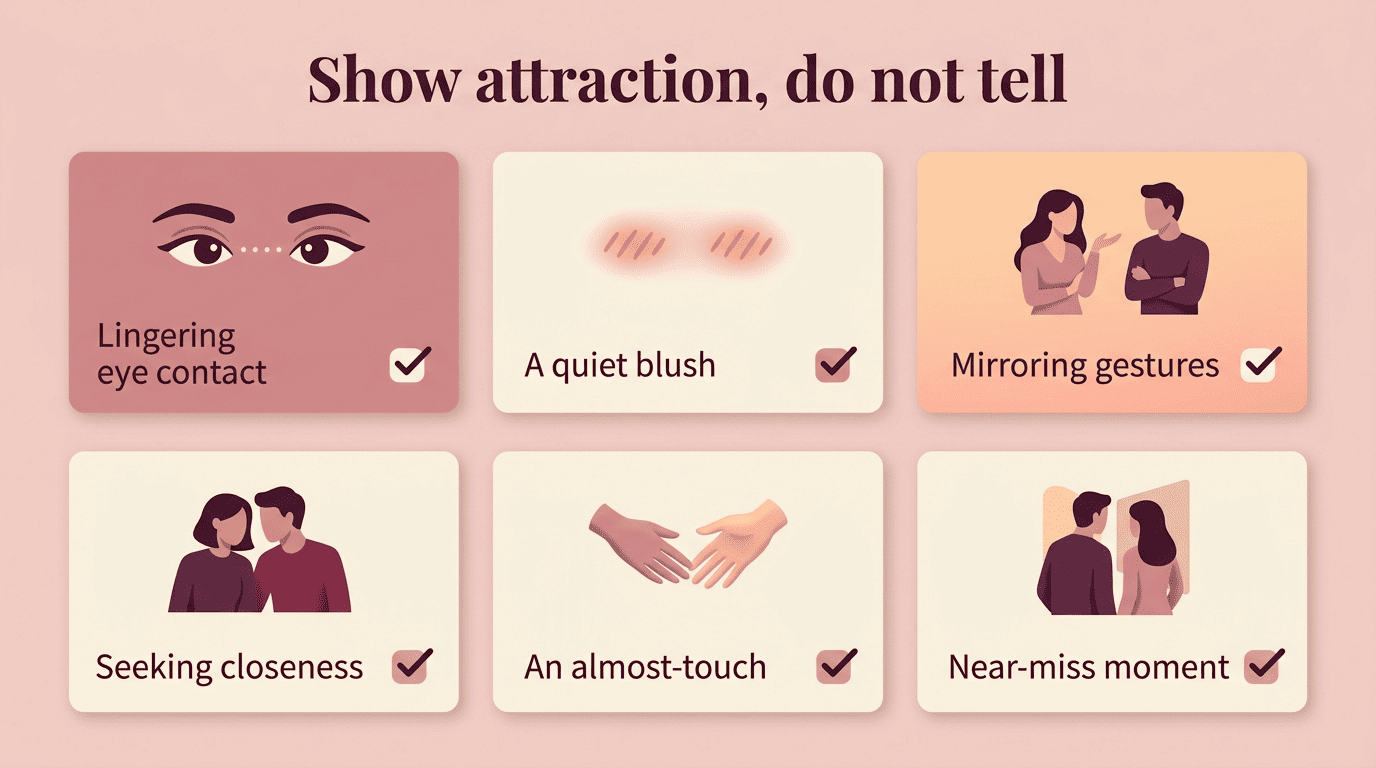
Show attraction physically without explicit content: lingering touches, locking eyes, a blush, seeking proximity, mirroring gestures. Escalate touch on a ladder — accidental, then necessary, then under a pretext, then justified, then without excuse. Emotional intimacy should run slightly ahead of the physical the entire way, so readers feel the heart catching up to what the body already knows.
- Lingering eye contact that lasts a beat longer than a normal glance
- A touch that starts as «necessary» (steadying a fall) and becomes remembered
- Mirroring — unconsciously copying the other’s posture or pace
- Seeking proximity without an obvious reason to be that close
Slow Burn Is Not a Slow Book: Pacing and POV
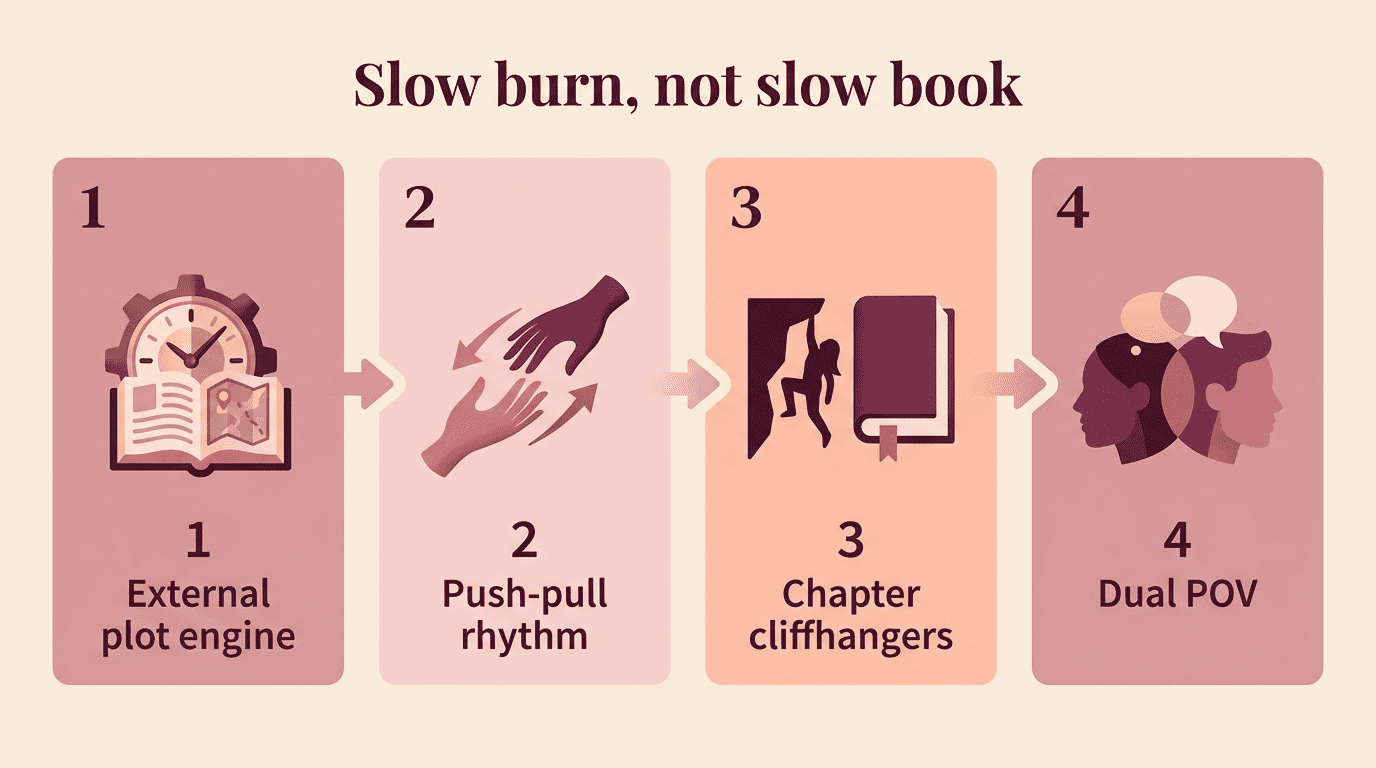
«Slow BURN, not slow BOOK.» That distinction matters more than almost any other rule in the genre. Run the romance as a subplot to an external engine — a quest, a mystery, a competition, a deadline — so the story keeps moving even while the relationship takes its time.
Keep the plot moving
Most readers don’t actually want a slow-paced novel; they want a slow-burning relationship living inside a fast-moving story. Give the plot its own stakes — a case to solve, a competition to win, a secret to uncover — and let the romance develop in the margins of that momentum.
Pacing tools: cliffhangers, POV, push-pull
- End chapters on small emotional or plot cliffhangers, not just action beats.
- Alternate or dual-POV chapters so readers feel both characters’ internal pull, not just one side’s.
- Use a push-pull rhythm — advance the relationship, then have a character retreat — instead of a straight climb.
- Hand out small partial payoffs (a confession half-made, a touch not pulled away from) between the bigger beats.
- Raise the emotional stakes of each retreat so the push-pull never feels like stalling.
- Check every few chapters that the romance subplot is still tied to what the external plot needs.
- Trim any chapter where neither the plot nor the relationship moves forward.

Handle Intimacy Tastefully: Emotional Intimacy and Fade to Black
The most memorable slow-burn moments are emotional, not graphic: a shared secret, a moment of true vulnerability, being truly seen by another person for the first time. A well-built ai fiction writing tool is useful exactly here — for workshopping the emotional beat, not the explicit one.
Emotional intimacy carries the weight
Let emotional intimacy lead the scene and the reader’s imagination do the rest. A conversation where a character finally admits the thing they’ve never told anyone can carry more romantic charge than any physical description, because it’s the vulnerability — not the act — that readers remember.
The fade-to-black technique
Fade to black is a craft choice, not a cop-out — the writer cuts away at the threshold and lets suggestion, implication, and the morning-after do the work. This keeps the story tasteful and lets you write for a wider audience without losing any of the heat that built up to that point.
Land the Payoff at the Right Moment
The payoff is the scene the entire slow burn has been building toward, and its placement matters as much as its content. Land it too early and the rest of the book deflates; land it too late and readers feel cheated of time with the couple they’ve been rooting for.
Where the beats fall
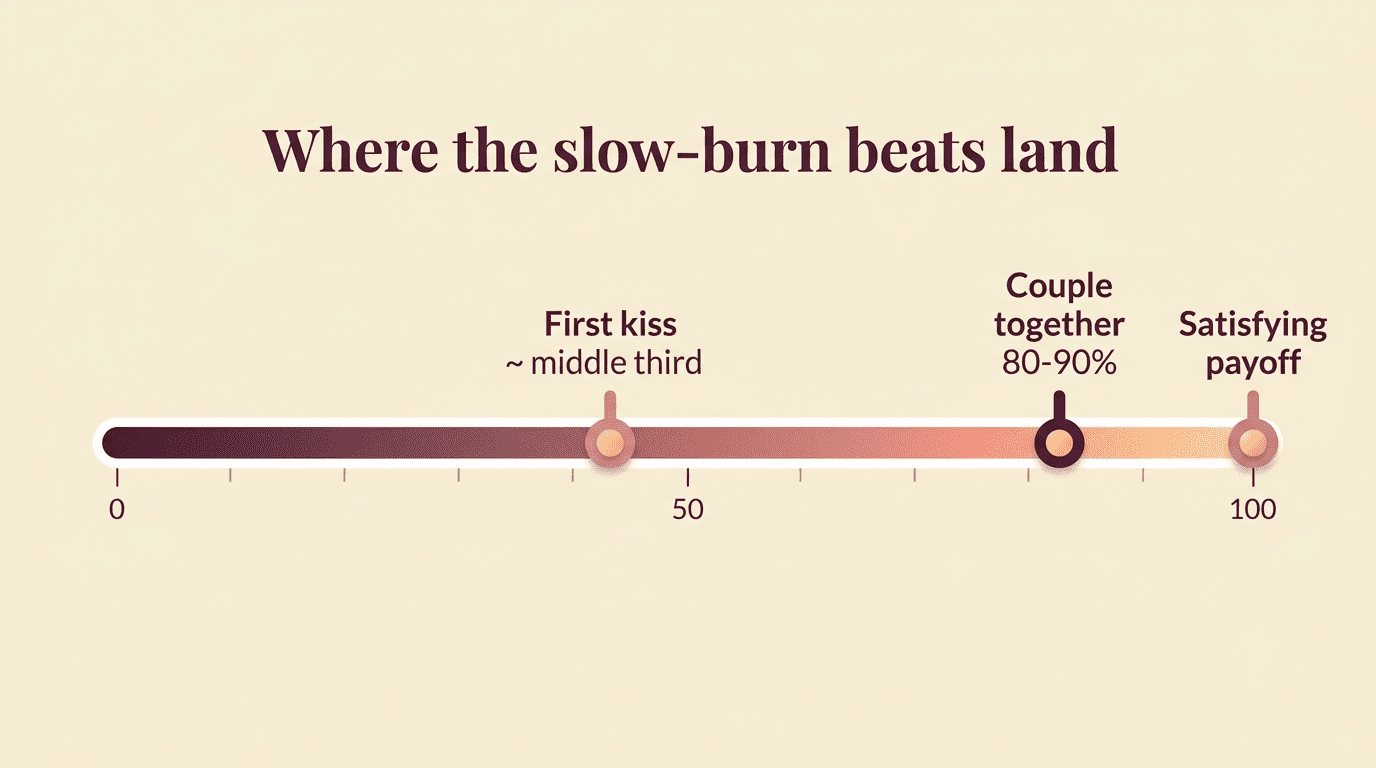
The first kiss typically lands around the middle third of the story — an early spark of physical connection that isn’t yet the full resolution. For a standalone novel, the couple usually comes together for good at roughly 80–90% of the way through, so readers get real time with them as a couple before the book ends. In a fantasy series or multi-book arc, that beat can land anywhere from 75–90% or shift to the final act of the overall arc. Either way, resolve the major obstacles before the union, so the moment feels earned rather than convenient.
Make it inevitable and satisfying
The payoff should feel both surprising and inevitable — everything in the story was quietly pointing here, even if the reader didn’t consciously notice until this scene. Reward the reader with visible growth in both characters and a genuinely memorable climactic scene; avoid an instant, unearned fix where the obstacle simply evaporates.
Pick a Trope to Frame the Burn
A trope is a ready-made engine for obstacles and tension, which is why so many slow burns lean on a recognizable one rather than inventing a barrier from scratch.
| Trope | Tension it supplies |
|---|---|
| Enemies-to-Lovers | Built-in conflict that has to be dismantled beat by beat |
| Friends-to-Lovers | Fear of ruining an existing relationship |
| Forbidden Love | External stakes and social or family consequences |
| Second Chance | Shared history plus unresolved regret |
| Opposites Attract | Friction from mismatched values or habits |
| Forced Proximity | Physical closeness neither character chose |
| Workplace | Professional stakes tangled with personal ones |
The classic slow-burn tropes
Enemies-to-Lovers supplies built-in conflict. Friends-to-Lovers runs on the fear of ruining what already exists. Forbidden Love adds external stakes. Second Chance brings history and regret into the same room. Opposites Attract, Forced Proximity — the «only one bed» scenario — and Workplace romance round out the list. Each one hands the writer a ready-made obstacle engine instead of requiring one built entirely from scratch.
Common Slow-Burn Mistakes to Avoid
- Dragging without progress — the relationship stalls for chapters at a time. Fix it with small partial payoffs that keep readers feeling forward motion.
- No chemistry established early — obstacles mean nothing if readers never wanted the pairing in the first place. Build shared moments and banter from the earliest scenes.
- Contrived misunderstandings — barriers that a two-minute conversation would solve. Give every obstacle a real, character-rooted reason.
- Losing focus on the plot — the romance drifts away from the external story engine. Tie every romantic beat back to what the plot needs from these characters.