
How to Write Romantic Tension: The Craft of Slow Burn, Longing, and Will-They-Won’t-They
Romantic tension is the invisible current that keeps readers turning pages long past midnight — the suspense of two people orbiting each other before their union is ever certain. Whether you draft by hand or lean on an ai romance writing assistant to pressure-test your scenes, the mechanics are the same: give two characters a powerful desire for each other, then put believable forces in the way.

This guide breaks romantic tension down into a repeatable craft — the desire-resistance-vulnerability formula, the push-pull dance, the obstacles that generate suspense, and the show-don’t-tell techniques that make a single hand-brush electric — all handled tastefully, on the page.
What Romantic Tension Actually Is (and How It Differs From Sexual Tension)
Romantic tension is the reader’s sustained uncertainty about when — or whether — two characters will come together. It’s a story-length question, not a single steamy moment, and it can carry a novel for hundreds of pages without a single kiss.
Tension is a question, not a scene
Every strong love story asks one implicit question on page one and refuses to answer it until the end: will these two people end up together, and what will it cost them to get there? Individual scenes raise the stakes on that question — a shared glance, a near-miss, an argument that reveals too much — but no single scene resolves it. That’s what separates tension from a fling.
Romantic vs. sexual tension
Romantic tension is about the future of the relationship — will they end up together, and will it last? Sexual tension is about the immediate physical pull two characters feel in a given moment. According to Merriam-Webster’s definition of chemistry, the word describes «a strong mutual attraction, attachment, or sympathy» — which is really the raw material both kinds of tension draw from. The best love stories layer romantic and physical tension together, but tension that rests on physical attraction alone burns out fast, because the reader has nothing left to wonder about. This is a craft guide about the emotional architecture behind a love story, not about explicit content — intimacy on the page is handled by suggestion, which we cover later.
A scene has romantic tension, not just a passing spark, when it includes:
- A specific, felt reason each character wants the other — not just physical attraction
- A believable reason they can’t or won’t act on it yet
- Something at stake if the relationship fails or succeeds
- A question the reader is left wondering about after the scene ends
The Core Formula: Desire + Resistance + Vulnerability
Romantic tension requires desire and resistance in the same scene, at the same time, pulling the same two people in opposite directions. Take either one away and the scene collapses — all desire with no resistance reads as a couple already together, and all resistance with no desire reads as two people who simply don’t like each other.
Flat or boring characters who are underdeveloped are never going to light up a scene, no matter how many tricks you pull.
Savannah Gilbo, story coach and podcast host
That’s the foundation underneath every technique in this guide: fully fleshed characters first, craft second. Chemistry itself is built from vulnerability, desire, and resistance working together — pull any one out and the other two go slack.
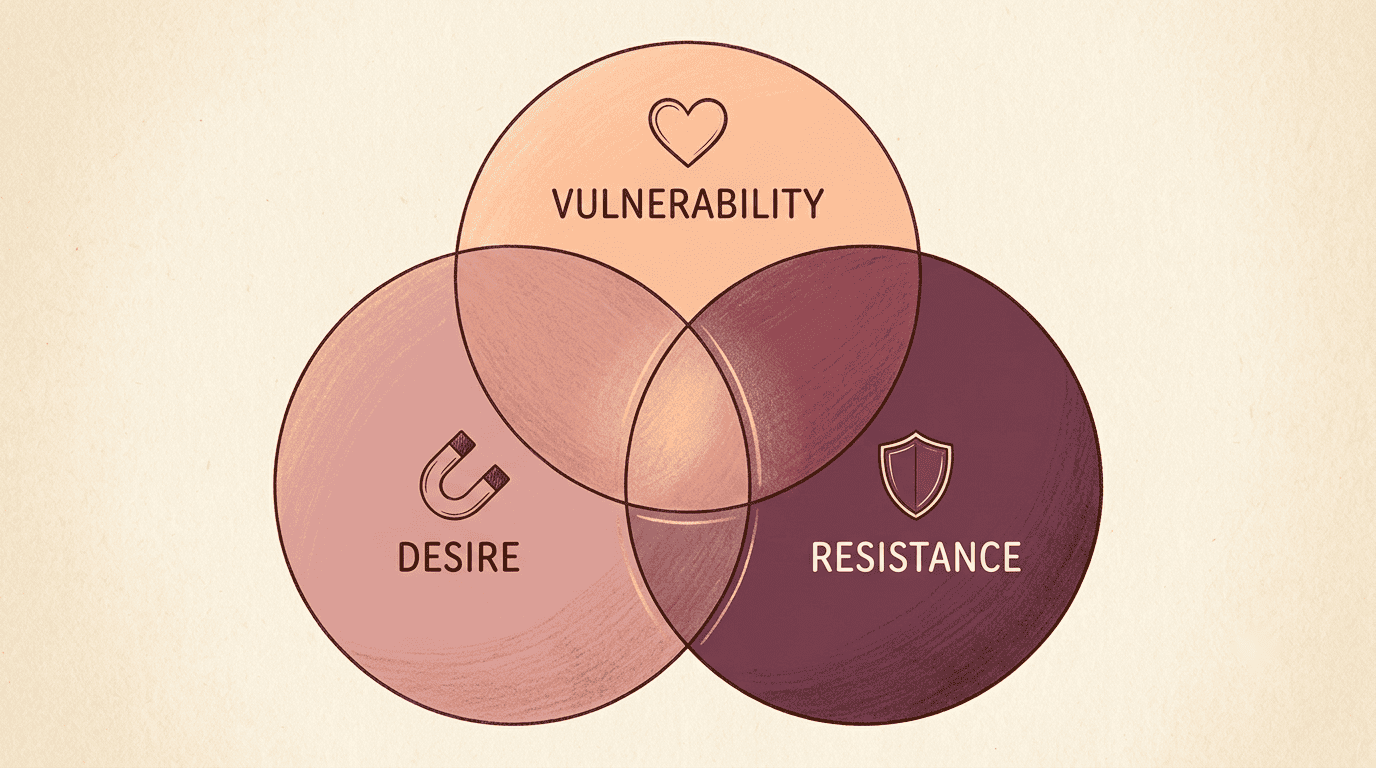
Desire pulls them together
Give each character a specific, felt reason to want the other — not just looks. Desire is the engine of the whole story; it has to be concrete enough that the reader feels it too, whether that’s admiration for a specific skill, relief at being understood, or the thrill of being challenged.
Resistance holds them apart
Resistance is the refusal to act on desire: pride, past hurt, a rival goal, an incompatible life, a promise made to someone else. Without resistance there is no tension — only a couple who happen to like each other, with nothing left for the reader to root for.
Vulnerability sits in the middle
Vulnerability — letting weakness, fear, or hope be seen, even briefly — is what makes desire feel earned and resistance feel costly. A character who never risks being hurt never really wants anything, and a character who never lowers their guard never really resists anything either.
The Push-Pull Dance: Pacing Your Slow Burn
Romantic tension isn’t static — it needs a push-pull dynamic that produces genuine will-they-won’t-they suspense from one scene to the next. A slow burn delivers escalating scenes over time rather than one big confession, and that escalation is what keeps a reader from skimming ahead.
Two steps forward, one step back
Each scene should nudge the couple closer or farther apart — never flat. Peel back one «onion layer» of a character’s guard, then let them retreat behind a new one. Author Anne Gracie describes the mechanism this way:
Throw your characters into a crucible—and then add heat.
Anne Gracie, romance novelist
A crucible is simply a situation the characters can’t easily walk away from — a shared assignment, a small town, a family obligation. Once they’re locked in together, every scene has somewhere to apply pressure.
Escalate frequency and intensity
Slow burn works because encounters get closer together and higher-stakes as the book progresses. A little tension dropped on every page compounds into a payoff the reader has been anticipating for three hundred pages, which is exactly why it lands harder than a single big scene ever could.
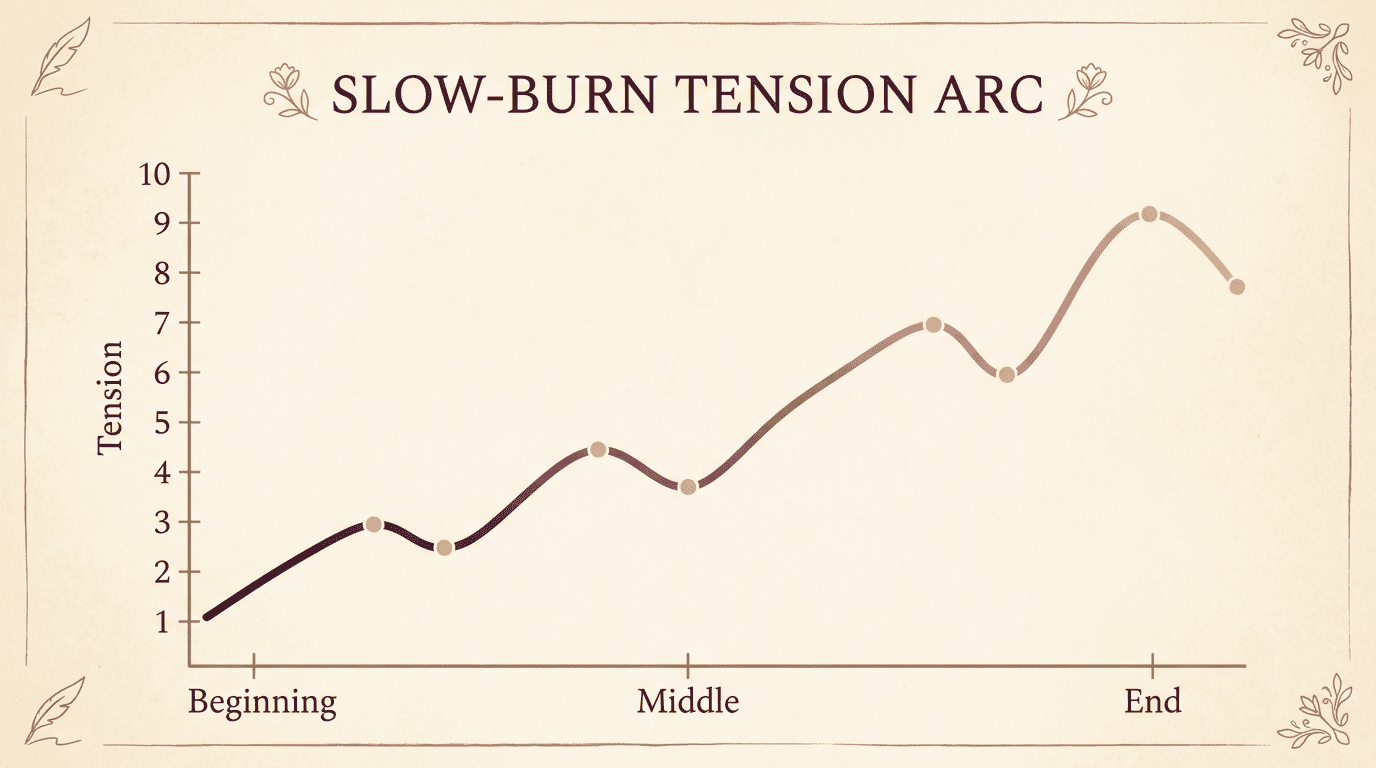
Here’s a simple way to plan the escalation across a manuscript:
- Map every scene where the two leads appear together and note the «temperature» of that scene, from 1 (barely aware of each other) to 10 (can’t stay apart)
- Check that the numbers trend upward across the book, even with dips
- Insert a «two steps forward» beat any time three consecutive scenes have moved in the same direction
- Place your crucible — the situation that traps them together — by roughly the 25% mark
- Reserve your highest-temperature scene for the point just before the final obstacle
- Add at least one retreat («one step back») after your highest-tension scene to delay resolution
- Confirm the very last scene between them finally answers the question the whole book has been asking
Use turning points and a crucible
Lock the pair together under real pressure — a forced project, a shared danger, a secret only they know — so that leaving isn’t a realistic option. Slow-burn pacing is its own well-documented craft tradition; the concept of unresolved sexual tension describes exactly how deliberately delayed payoff builds investment across film, television, and fiction alike.
Obstacles: The Rival, the Situation, and the Misunderstanding
Romantic tension is created by obstacles, and the strongest stories mix more than one kind so the reader can’t predict how the couple will finally get past them. Obstacles generally split into two families:
| Obstacle type | Where it comes from | Example |
|---|---|---|
| Internal | The character’s own psychology — insecurity, trauma, conflicting goals | A character who avoids commitment after a past betrayal |
| External | Forces outside the characters’ control — family, class, distance, duty | Feuding families, a long-distance posting, a rival business deal |
The rival divides affection or resources. A rival — a love triangle, a competing suitor, a person with a prior claim — forces a character to choose, and the choosing itself generates tension long before either romantic partner is settled on.
The situation keeps them apart by circumstance. A situation obstacle is external and often uncontrollable: opposing sides of a conflict, a class divide, a job that requires one of them to leave. Jane Austen leaned on exactly this kind of obstacle — first impressions, pride, and social rank — in Pride and Prejudice, still one of the clearest examples of push-pull tension in English fiction two centuries later.
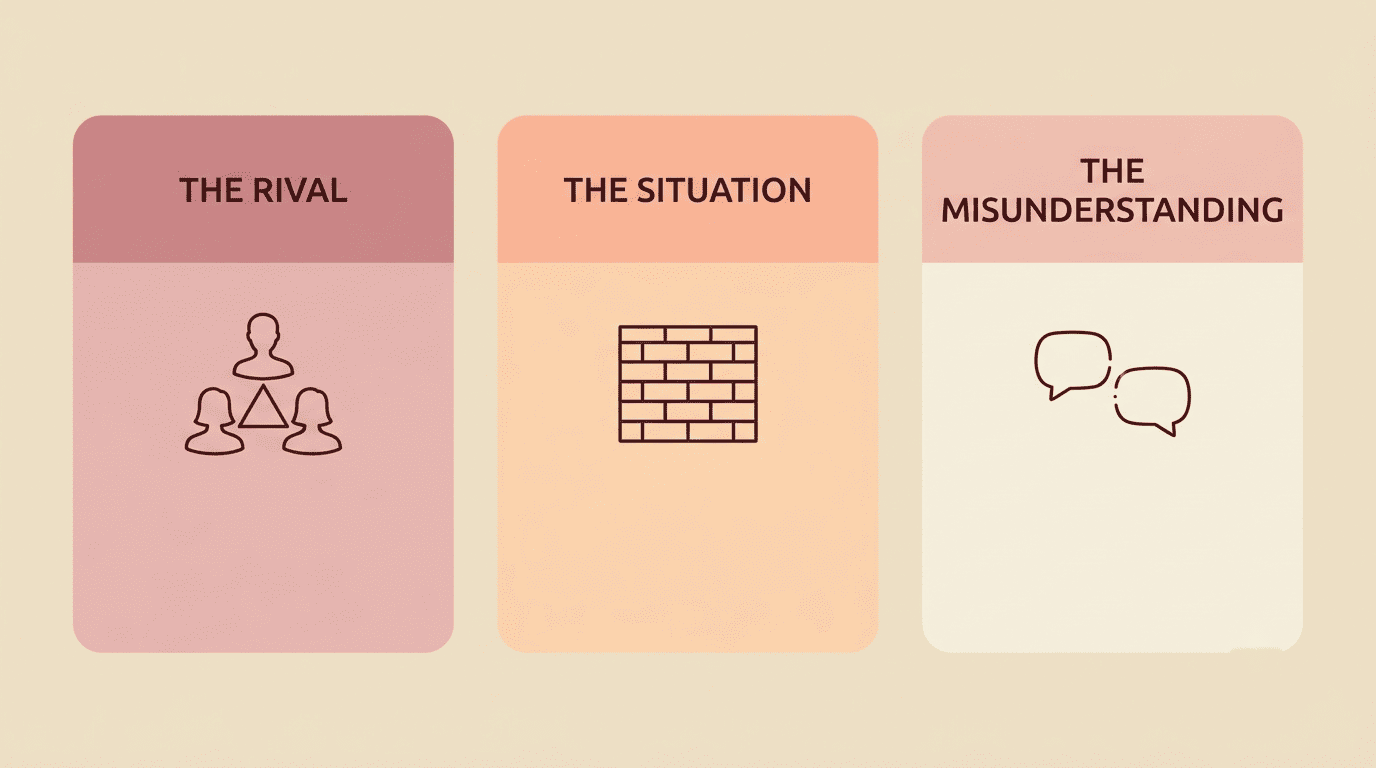
The misunderstanding works only in small doses. A brief miscommunication can create real friction — a text read the wrong way, an overheard half-conversation. But it’s worth guarding against the «Big Mis»: a book-long misunderstanding any reasonably honest adult would clear up in a single conversation. Readers forgive obstacles that come from character and circumstance far more readily than obstacles that only exist because two people refuse to talk.
Show, Don’t Tell: Subtext, Body Language, and Banter
Telling a reader that two characters «had chemistry» is a report, not an experience. Showing romantic tension means routing it through internal thought, physical detail, and dialogue instead of stating it outright.
| Method | What it does | Example |
|---|---|---|
| Internal thought | Lets the reader hear feelings too big to say aloud | A character noticing they’ve thought about the other three times before breakfast |
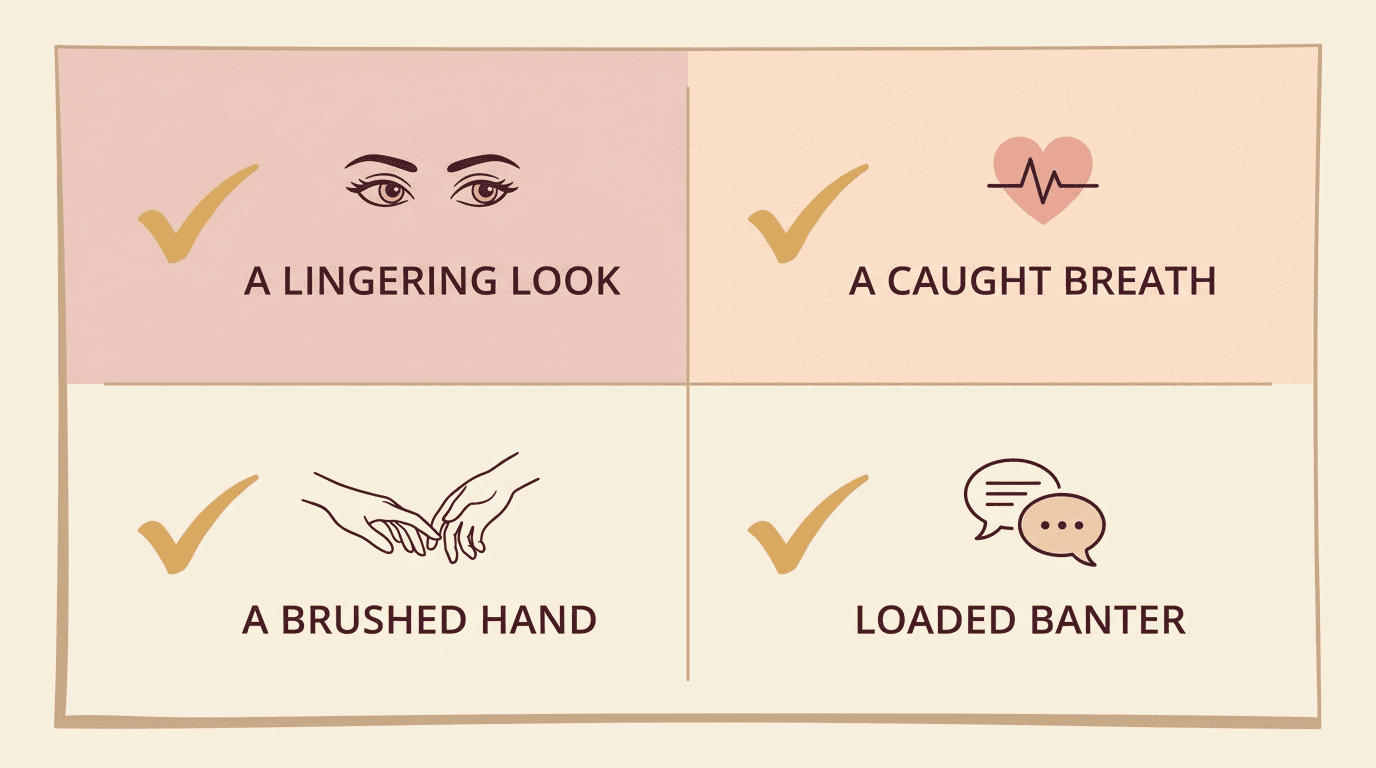
| Body reactions | Signals attraction the character hasn’t admitted yet | A caught breath, a brushed hand, an accelerated heartbeat |
| Banter and subtext | Says one thing while meaning another | A needling nickname that’s really a term of affection |
| Something missing | Absence reveals what a character wants | Restlessness or distraction whenever the love interest is out of the room |
Interiority and longing
Interiority is the most-used tool in a writer’s kit for this exact job: once two characters have met, no scene should pass without one of them registering the other, even briefly. Leaving the longing out of dialogue and routing it through thought instead can make it stronger — the reader knows something the other character doesn’t.
The physical tell
A brushed hand, a caught breath, a stomach that tightens for no obvious reason — small, specific bodily reactions do work that explicit description can’t. They’re deniable to the character experiencing them, which is exactly what keeps the tension alive.
Banter and subtext
Witty, needling dialogue that says one thing and means another is tension the reader can hear out loud. Inside jokes, pointed nicknames, and arguments that both people secretly enjoy all signal a connection neither character is ready to name.
Tropes That Manufacture Tension (Enemies-to-Lovers, Forced Proximity)
Popular romance tropes aren’t shortcuts around craft — they’re scaffolding for the same desire-and-resistance engine, pre-loaded with a specific flavor of obstacle.
- Enemies-to-lovers front-loads resistance by giving the pair a genuine history of conflict to overcome
- Friends-to-lovers front-loads desire by giving the pair years of positive memory and trust already in place
- Forced proximity strips away the easiest escape — a snowbound cabin, a shared assignment, a long flight — so avoidance stops being an option
- Fake dating manufactures physical closeness and public intimacy before either character has admitted anything privately
An ai fiction writing tool can be useful here precisely because tropes are so recognizable: it can flag when a scene is leaning on the label instead of the specific people in it, which is the difference between a trope that feels fresh and one that feels generic.
Make the trope yours
Subvert the reader’s expectation somewhere — let the specific characters and their particular history, not the label on the cover, drive what actually happens in each scene. MasterClass’s guide to writing romance makes the same point about tropes in general: they work as a starting scaffold, not a finished blueprint.
Handling Intimacy Tastefully: Fade to Black and Suggestion
Fade to black is a tasteful intimacy technique: the scene escorts the couple to the threshold, then cuts away and lets the reader’s imagination finish it. It’s a deliberate craft choice, not a limitation — plenty of beloved, bestselling love stories never go further than a closed door, because the anticipation built over the preceding chapters is the actual point.
What fade to black does
The technique works because everything that made the moment matter — the desire, the resistance, the vulnerability — has already happened on the page. What’s left is private, and leaving it there respects both the characters and the reader.
Emotional intimacy over explicit detail
A whispered confession, a held gaze, a name said softly in a quiet room — emotional exposure is usually the real payoff of all the tension a writer has been banking for chapters, and it often lands harder on the page than physical description ever could. A romance writing ai can help draft that scene at exactly the register you want — suggestive rather than explicit — while you keep the emotional truth of the characters intact.
Common Mistakes That Kill Romantic Tension
Resolving the tension too early. The moment the central question — will they or won’t they — gets answered, tension dies. Protect the «not yet» for as long as the story can bear it, and give the couple a reason besides plot convenience to keep circling each other.
Telling instead of showing. «They had amazing chemistry» is a summary, not a scene. Dramatize the moment instead: the noticed detail, the missed beat in conversation, the reaction a character tries to hide.
Leaning only on the physical. Tension built solely on physical attraction is thin and forgettable — it needs the emotional stakes from the desire-resistance-vulnerability formula layered underneath it, or the reader stops caring who ends up with whom.
Overusing the Big Mis. A misunderstanding that could be resolved with one honest sentence, stretched across dozens of chapters, tends to frustrate readers rather than hook them.
A quick pre-revision checklist:
- Does every major scene move the central question closer to an answer or further from it — never sideways?
- Is at least one obstacle rooted in character, not just circumstance?
- Would one honest conversation solve the conflict? If yes, it needs another layer.
- Is there a physical tell or piece of interiority in every scene the two leads share?