
How to Write Intimate Scenes Tastefully: A Craft Guide for Romance & Fiction Writers
Writing an intimate scene that feels earned rather than gratuitous is one of the hardest craft skills in fiction, and one of the most misunderstood. Tasteful doesn’t mean timid: it means leading with emotion, trusting suggestion, and letting the door close at exactly the right moment, and a good ai romance writing assistant can help you draft those emotional beats before you touch a single sensory detail.

The most memorable love scenes in fiction often show very little. This guide covers what «tasteful» really means, fade to black and closing the door, suggestion and subtext, emotional intimacy and vulnerability, sensory-not-graphic build-up, choosing a heat level, when to close the door, and consent. It’s a craft article written for an 18+ audience, but every example here stays firmly on the tasteful side of the door.
What «Tasteful» Actually Means (Emotion Over Anatomy)
«Tasteful» is a craft choice, not a limitation, and confusing the two is where most new writers stumble. A closed-door scene can carry more heat than an explicit one, because anticipation and emotion are doing the work that description would otherwise have to do.
Tasteful is a craft choice, not a limitation
Tasteful doesn’t mean prudish, and it doesn’t mean the writer is avoiding difficulty. Outlander author Diana Gabaldon put it plainly in her own craft notes on the subject:
A good sex scene is about the exchange of emotions, not bodily fluids.
Diana Gabaldon
Bestselling romance author Nora Roberts has made a related point for decades: «Action, reaction, motivation, emotion, all have to come from the characters. Writing a love scene requires the same elements from the writer as any other.» The reader doesn’t remember the mechanics of a scene; they remember what it revealed about the two people in it. That single shift in focus, from body to character, is the entire foundation of writing intimate scenes well.
The reader supplies the intensity
Readers co-author intimate scenes inside their own imagination. Hand them a clear emotional truth, a few charged sensory anchors, and get out of the way; what they picture themselves is more personal, and often more intense, than anything a writer could spell out on the page. This is the engine behind every tasteful love scene, romantic scene, or intimate moment that has stuck with readers for generations, from Jane Austen forward. Suggestion isn’t a workaround for explicit content. It’s the actual craft skill.
Fade to Black: Closing the Door With Intention
Fade to black is the single most useful tool in a tasteful writer’s kit, and it’s worth understanding as a deliberate device rather than an evasion.
What fade to black means
Fade to black describes the moment the narrative «camera» pulls away at the threshold of an intimate scene and rejoins the characters afterward. The emotional lead-in and the aftermath both stay on the page; the act itself does not. The term borrows directly from film and television’s fade-to-black transition, where the screen dims to signal that time has passed without showing what happened in between. In romance-writing shorthand, this is the difference between a «closed door» and an «open door» scene: how much of the encounter the reader is shown versus how much is implied.
| Door Type | What’s on the page | What’s implied |
|---|---|---|
| Closed door / fade to black | Emotional build-up, the transition moment, the aftermath | The physical act itself |
| Emotional | Interiority, feeling, a charged image at the threshold | Most physical detail |
| Emotional + physical (open door) | Sensory and physical detail alongside emotion | Little is left off-page |
A non-explicit fade-to-black example
Here’s how the cut actually works in practice, staying entirely on the tasteful side:
She reached for the top button of his shirt, and he caught her hand, pressing it flat against his chest instead — like he needed to feel her decide. «You’re sure,» he said. Not a question. She answered by closing the last inch of space between them.
Morning light found the room first. Coffee, two cups, going cold on the nightstand. She traced the seam of his shoulder blade with one finger, and he laughed, low, into the pillow.
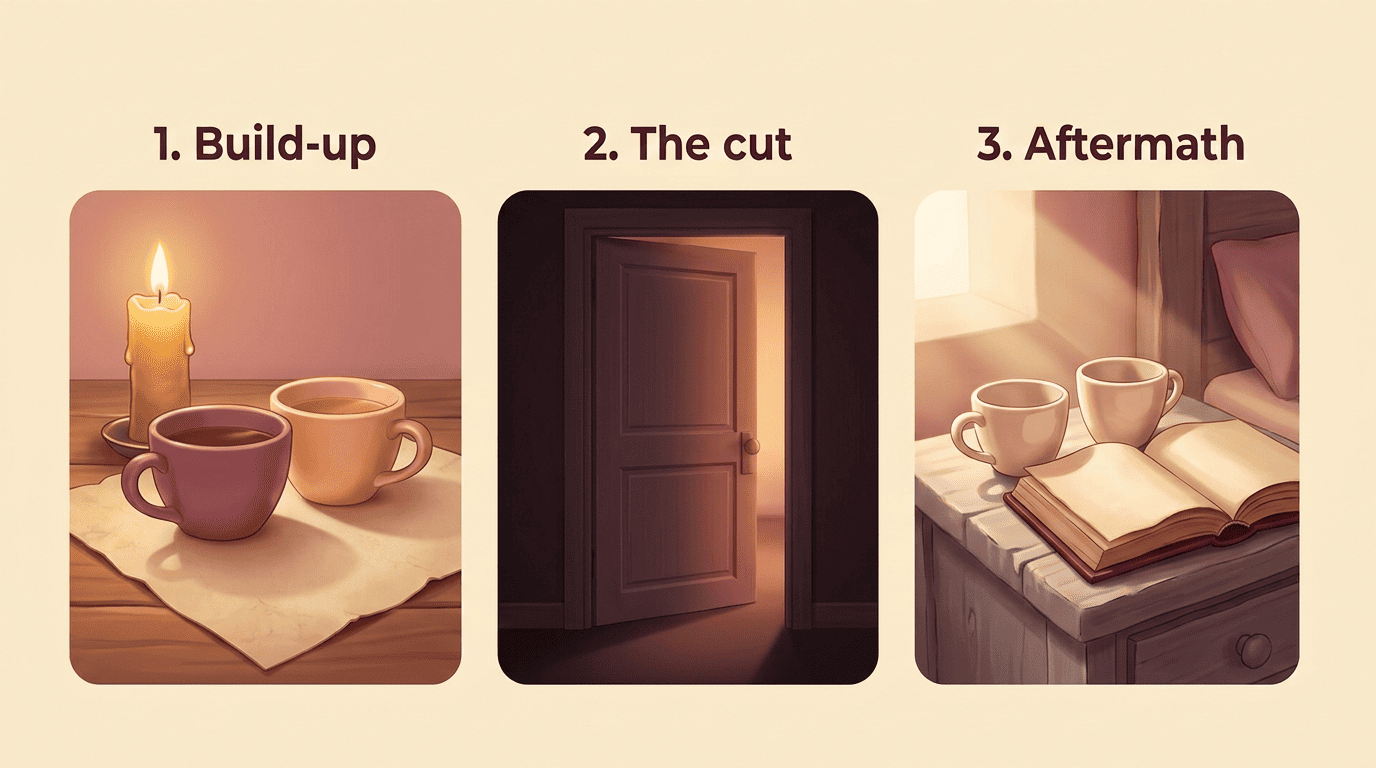
The scene cuts at the moment of decision, on a held gaze and a physical gesture that says everything the dialogue doesn’t, and rejoins the characters in the aftermath, where the coffee cups and the laughter tell the reader what happened without a single graphic word. That’s the craft: the cut lands on an emotional beat, not mid-sentence, so nothing feels withheld.
When the door should close
Close the door when the scene’s real job is emotional, meaning trust, surrender, or a turning point in the relationship, rather than physical description. Close it when your genre or publishing line expects it (inspirational romance and many cozy or category lines close the door by convention). And close it when you’re not confident writing explicit content on the page; readers can sense faked confidence from a mile away. Closing the door is a deliberate tool a writer reaches for, not a failure of nerve.
Suggestion, Implication, and Subtext
Suggestion is what separates a tasteful scene from a clinical or an overwrought one, and it works through two related techniques: the camera angle and the objects in the room.
The camera-angle technique
Think of the scene the way a director frames a shot. You can zoom in on one charged, non-graphic detail, a caught breath, a fingertip tracing a collarbone, or you can pan away entirely to the aftermath: tangled sheets in morning light, two coffee cups going cold. One precise detail creates more intimacy than a full inventory of what happened, because specificity reads as truth and abundance reads as filler.
Let setting and objects carry the subtext
Environment does quiet work that dialogue can’t. Rain against a window, a coat dropped on the floor, a candle burning down to nothing, all of these imply without stating. Used well, they let the reader feel the temperature of a scene before a single line of interiority confirms it.
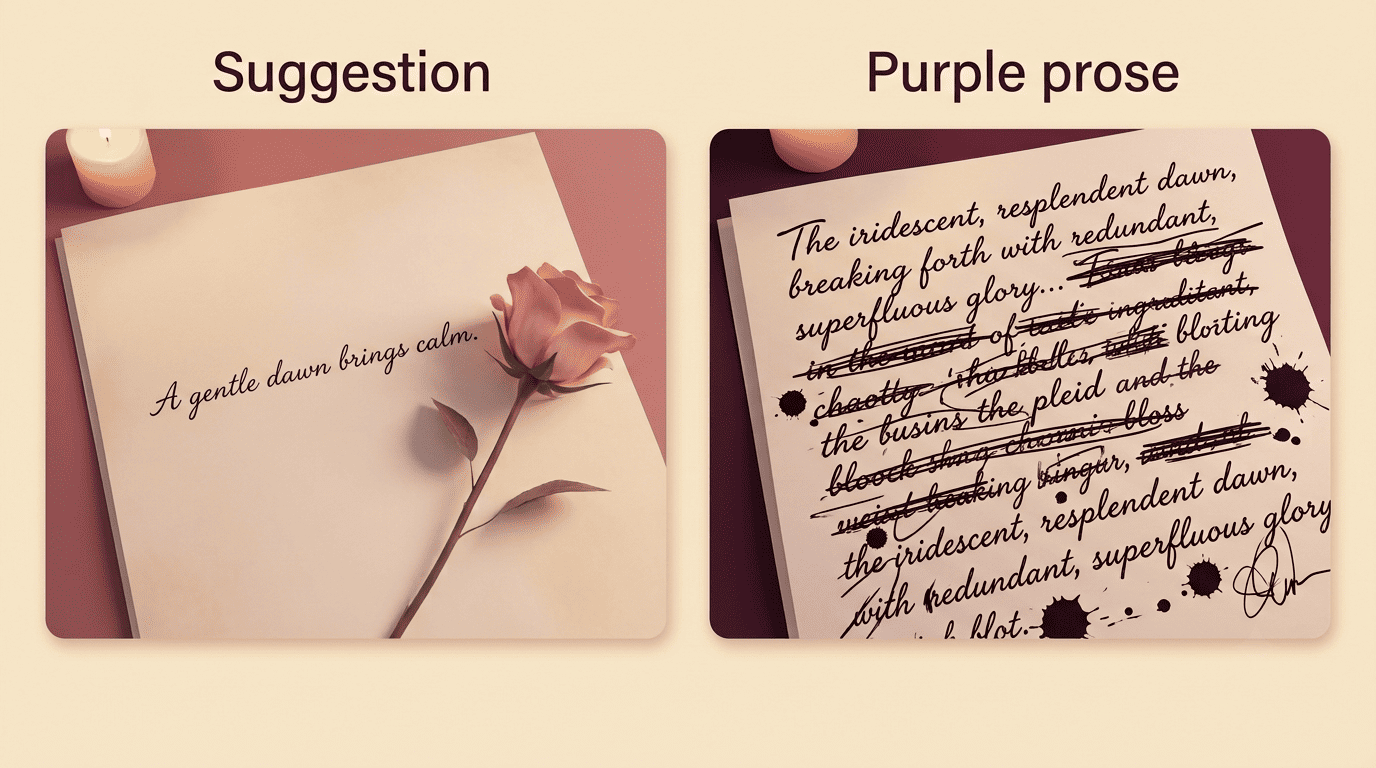
The table below lays out the difference between suggestive craft moves and the two failure modes that read as «trying too hard»:
| Craft Move | Reads As |
|---|---|
| A single charged sensory detail (a caught breath, a fingertip) | Suggestive, intimate |
| Environment as metaphor (rain, a dropped coat, a dying candle) | Subtext, atmosphere |
| Overwrought euphemism, stacked adjectives | Purple prose |
| Clinical or anatomical terminology | Detached, clinical |
Lead With Emotional Intimacy and Vulnerability
Every tasteful intimate scene is, underneath the sensory detail, a scene about vulnerability. If the emotional risk isn’t on the page, no amount of atmosphere will make the scene land.
Intimacy is what a character lets you see
A useful mnemonic for this is «in-to-me-I-let-you-see»: intimacy is defined by what a character risks revealing, not by physical proximity. What makes a scene intimate is the emotional stake each person takes on, not the mechanics of what their bodies are doing. Diana Gabaldon, author of the Outlander series and of the craft guide I Give You My Body on writing intimate scenes, describes conveying emotion through three channels: dialogue, facial expression, and action. A tasteful scene leans on all three before it leans on anything physical.
Stay inside one point of view
Interiority is the most tasteful tool available to a writer, because filtering everything through one character’s thoughts keeps the scene emotionally anchored instead of visually catalogued. Avoid head-hopping between two characters’ perspectives mid-scene; one point of view per scene lets internal reaction, rather than external description, carry the moment. This single discipline does more to keep a scene from feeling explicit or clinical than any amount of careful word choice.
Build Sensory Tension Without Getting Graphic
Engage all five senses, not just sight. Touch, sound, smell, and even taste create heat without a single graphic word: the smell of rain and cedar on a coat, the sound of a caught breath, the warmth of a hand closing over another. A shared bite of something, say olives instead of strawberries, can set an entirely different tone for a scene through taste alone; that single sensory choice does more tonal work than paragraphs of physical description.
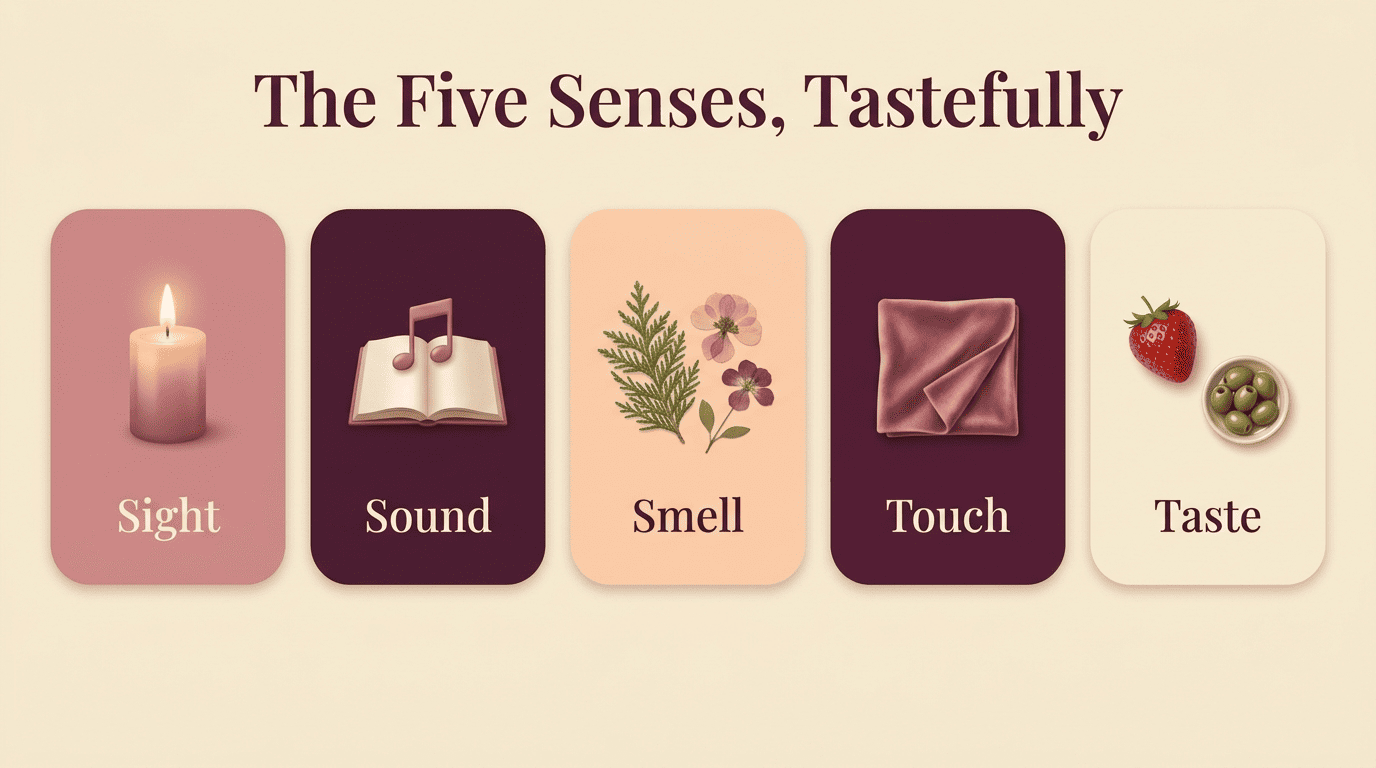
Anticipation is the whole game. Tension lives in the almost: the pause before a first kiss, the space between two people who both already know what’s coming. Delay is not a stalling tactic, it’s the actual content of a tasteful scene.
Vary your sentence length for pacing. Short, clipped lines quicken the pulse; longer, unbroken ones slow the moment down and let it breathe. Alternating between the two mimics the rhythm of the scene itself.
Resist the urge to name everything. A sensory anchor is suggestive precisely because it’s incomplete; naming every sensation in sequence turns intimacy into inventory, and inventory reads as detached rather than close.
Choosing Your Heat Level
Every romance or fiction writer eventually has to decide how much heat a scene, and a book, will carry. That decision should be made deliberately, not by default.
The heat spectrum
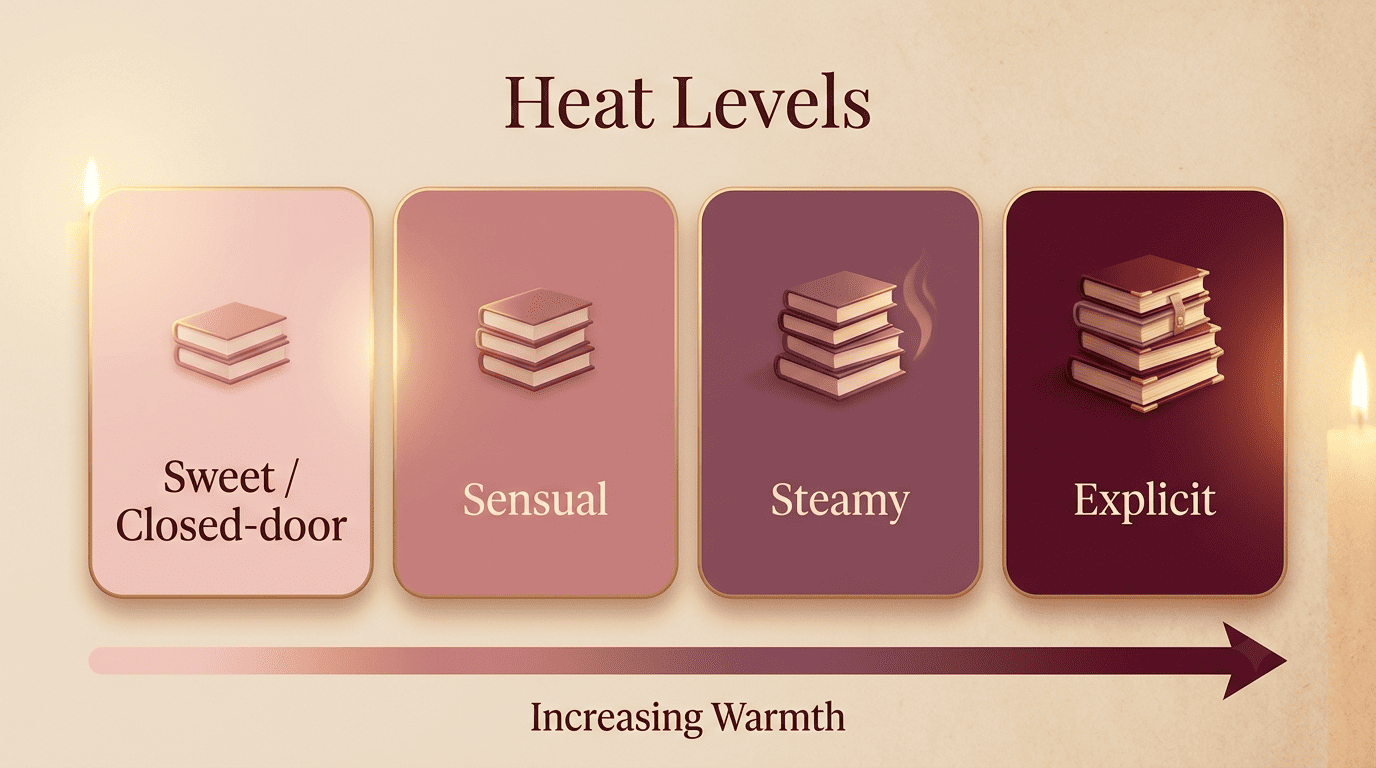
Heat level runs on a rough ladder, and it’s worth knowing where each rung sits before you draft a single scene:
- Sweet / closed-door — the door shuts entirely; the reader sees the lead-in and the aftermath only.
- Sensual — emotional and light sensory detail carries the scene; little is graphic.
- Steamy — more physical detail is on the page, but restraint still governs the language.
- Explicit — little is left to suggestion.
Publishing lines make this explicit in their submission guidelines, which is part of what defines the broader conventions of the romance novel as a genre. This guide, and the tasteful approach it teaches, lives at the closed-door and sensual end of that ladder — the same range a romance writing ai is best used for, since it can help you pressure-test whether a scene reads as sensual or has drifted into steamier territory than you intended.
Match heat to genre and to yourself
Two rules govern this choice. First, meet reader expectations for your subgenre or imprint: a sweet contemporary and a steamier category line make different promises to readers before page one, and breaking that promise reads as a mistake rather than a stylistic choice. Second, write to your own comfort level. A scene pushed past what an author is actually comfortable writing tends to read as forced, because readers pick up on hedged, uncertain prose even when they can’t name why it feels off. Closed-door is a legitimate, widely read choice across the genre, not a lesser one.
Here’s a quick way to sanity-check your own heat level before you draft:
- Identify what the scene needs to accomplish emotionally (trust, surrender, a turning point).
- Check your genre or publishing line’s conventions for how much is typically shown.
- Draft the emotional lead-in first, before any physical detail.
- Choose a camera-angle technique: zoom on one detail, or pan to the aftermath.
- Write the scene at the heat level you’re genuinely comfortable sustaining, not the one you think readers expect.
- Reread for purple prose or clinical language, and cut both.
- Confirm the scene changes something between the characters before you keep it.
Consent and Character Emotion
Consent is not a side issue in an intimate scene; it’s part of the same emotional architecture that makes the scene tasteful in the first place.
Consent belongs on the page
Consent isn’t a legal checkbox tacked onto a scene; it’s characterization, and it deepens trust both between the characters and between the reader and the author. It can be woven in naturally through dialogue, a checked-in glance, a moment of hesitation answered clearly, rather than an interruption to the mood. Done well, visible enthusiastic consent heightens intimacy instead of breaking it, because it’s one more piece of vulnerability on the page.

Every intimate scene must change something
Apply a simple story test: if the scene could be deleted and nothing shifts in the relationship or the plot, it’s decoration rather than craft. A tasteful scene earns its place by moving the characters forward, whether that’s new trust, new vulnerability, or a clear turning point. In practice, a physical scene in a romance novel is really a love scene with an emotional payoff; strip the payoff away and there’s no reason for the scene to exist.
Common Mistakes to Avoid
Most tasteful scenes fail for the same handful of reasons, and nearly all of them are fixable before a scene ever reaches a reader.
The «ick» factor and how to dodge it
Two root causes tend to produce what editors call the «ick factor»: the scene arrives before the reader is emotionally invested in the characters, and the prose leans on heavy external visuals with no interiority to anchor them. The fix for both is the same, earn the moment first through emotional build-up, then filter everything through feeling rather than description.
Don’t forget the aftermath
The moments after an intimate scene are where meaning actually settles, so don’t cut away before registering the emotional after-effect. Beyond that, watch for the same recurring traps:
- Purple prose and clinical language, which both fail in opposite directions.
- Treating a couple’s first intimate scene exactly like their fifth, when the emotional stakes have clearly changed.
- Skipping the emotional build-up entirely, which turns a love scene into a mechanical one no matter how careful the sensory writing is.
- Cutting away before the aftermath, leaving the emotional payoff of the scene unregistered.