
How to Write Enemies to Lovers: A Craft Guide to the Slow-Burn Arc
Enemies to lovers is one of the most loved and most difficult tropes in romantic fiction — pulling it off means moving two characters from real hostility to real love in a way the reader believes at every step. As MasterClass’s guide to romance writing notes, tension in romance fiction has to be built through specific, escalating stakes rather than manufactured misunderstanding, and whether you outline by hand or draft with an ai romance writing assistant, the underlying mechanics stay the same.
The short version: make the hostility mean something, build the connection gradually through forced proximity and vulnerability, and keep both characters morally complex from the first page to the last. Handled well, the arc earns its ending; handled carelessly, it reads as either implausible or, worse, as excusing behavior it shouldn’t.

What the Enemies-to-Lovers Trope Really Is
Two characters start out as genuine adversaries — rivals, exes, opposing counsel, siblings’ worst enemies — and arrive at love only after working through real differences or real misunderstandings. The trope is not about mild bickering that melts away in a chapter; it’s a structural promise that the harder the starting distance, the more satisfying the closing of it.
Why readers love it
The trope maximizes the distance between «here» and «happily ever after,» and the wider that gap, the sweeter the eventual payoff. It reframes the story’s central question. Instead of asking «will they get together?» the enemies-to-lovers structure asks «how will they possibly get together?» — and that question is the real engine of tension, driving the reader forward chapter after chapter even when the plot outcome is never in doubt.
This is also why the trope pairs so well with high-stakes settings — workplace rivalries, warring families, opposing sides of a legal case — where the distance between the two leads is already built into the premise before the first page. The setting does part of the work of keeping them apart, so the writer only has to earn the part where they choose to close the gap anyway.
Enemies to lovers vs. hate to love vs. rivals to lovers
The three labels get used interchangeably online, but they describe different intensities. Rivals to lovers involves competition without real animosity — two ambitious people chasing the same prize. Hate-to-love arcs are often shorter and lighter, built on irritation rather than injury. True enemies-to-lovers stories carry real stakes: betrayal, opposing loyalties, or a history that actually did harm. A character who is merely annoyed by another is not an enemy — slight dislike isn’t enmity, and treating it as such is the fastest way to flatten the arc before it starts.
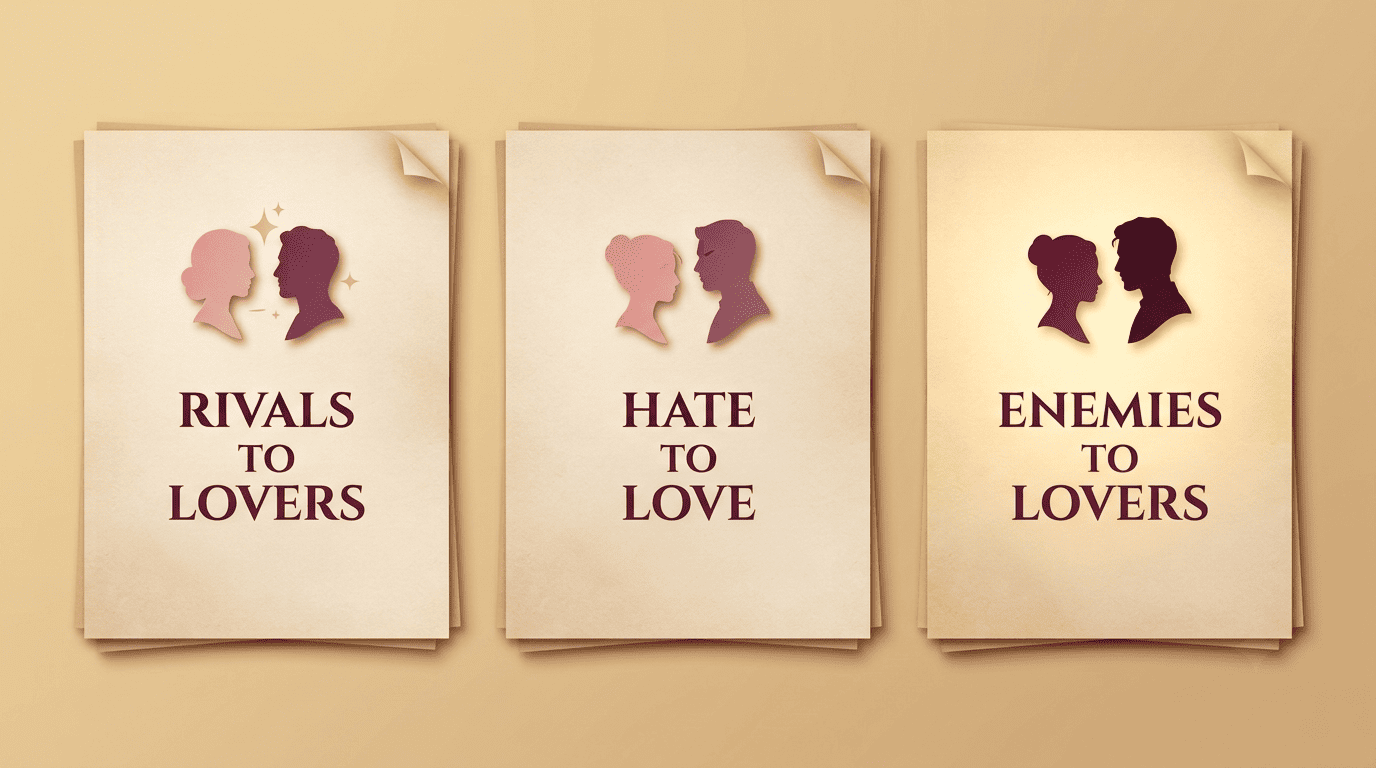
Naming which version is being written matters for pacing. A rivals-to-lovers plot can resolve in a handful of chapters once the competition itself ends, while a true enemies-to-lovers arc needs enough page time for real repair — not just a change of heart, but visible proof that the hurt has been addressed.
Start With Genuine, Meaningful Conflict
Every believable enemies-to-lovers arc begins with a reason the two leads are opposed that a reader would accept as legitimate on its own terms. Reedsy’s guide to writing conflict makes a related point about fiction craft generally: strong conflict needs clear, specific stakes for both sides, not a vague sense that two characters simply rub each other the wrong way.
Define exactly why they are enemies
The conflict needs a name. Vague friction reads as flat; a specific, nameable cause reads as real. Strong sources of conflict include:
- A past betrayal one character can’t forgive
- Directly opposing goals — both want the same job, land, or outcome
- A clash of core values neither is willing to compromise on
- Loyalty to opposing sides of the same fight, war, or family feud
Whichever source is chosen, write it down in a single sentence before drafting a single scene. If the conflict can’t be stated without a vague phrase like «personality clash,» a reader won’t accept it as real either, and every later beat in the arc will feel unearned.
Give both characters legitimate reasons (moral complexity)
If one character is simply villainous and the other simply virtuous, there’s no real journey — only a redemption arc for one side. Both leads need to be right about something and wrong about something else, with blind spots that make sense given what they know. That mutual moral complexity is what keeps a reader rooting for the relationship instead of waiting for one character to «fix» the other.
| Weak Conflict | Strong Conflict |
|---|---|
| Vague irritation or a bad first impression | Named betrayal, rivalry, or clash of values |
| One character is clearly right, one clearly wrong | Both have legitimate, defensible positions |
| Resolves the moment they talk it out | Requires real change from both sides |
| No real stakes if they never reconcile | Stakes that matter beyond the romance itself |
This is also where outlining pays off. Mapping out each character’s private justification for their behavior — even for scenes the reader never sees — keeps both sides consistent instead of letting one character drift into simple villainy whenever the plot needs friction.
Build the Arc: The Stages of Enemies to Lovers
The emotional shift from hostility to love rarely happens in a straight line — it moves through recognizable stages, and naming them makes the arc easier to plan and pace.
The emotional progression
One useful progression runs disdain, grudging respect, curiosity, denial, and finally acceptance. A tighter version compresses this into disdain, grudging respect, affection, and love. Denial is usually where the most tension lives — the point where a character recognizes the pull but actively resists it, often becoming more combative rather than less.
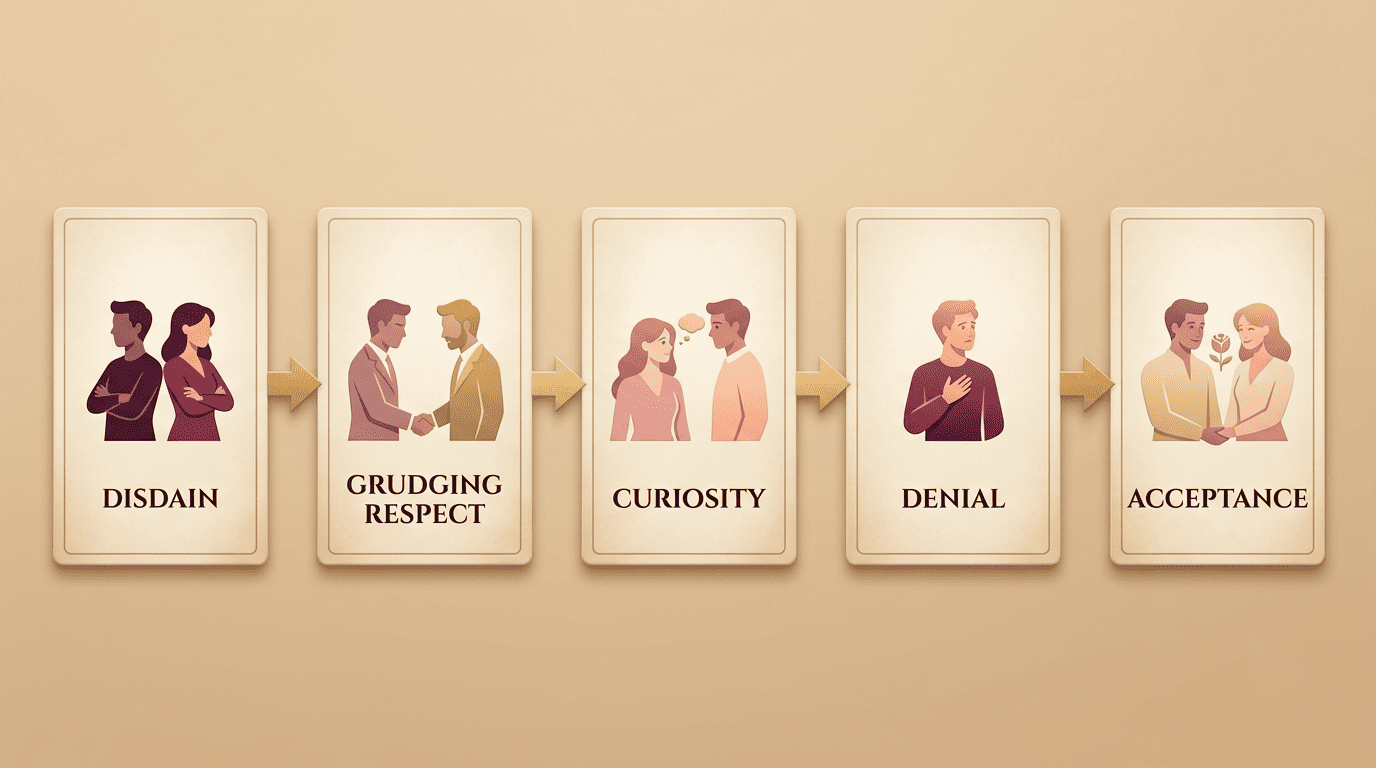
Whichever version is used, resist the urge to skip stages. A jump straight from disdain to affection reads as inconsistent characterization rather than chemistry, and readers notice the missing steps even when they can’t name exactly what feels off.
A beat structure you can borrow
A workable six-beat structure for the full arc looks like this:
- Establish the hostility clearly, with a concrete cause
- Introduce a catalyst — a shared goal or forced situation that puts them in the same orbit
- Let a subtle, early attraction surface, one neither character will admit to
- Build trust through small, earned concessions
- Test the relationship with a challenge to loyalty or trust
- Deliver the breakthrough moment where feelings are finally acknowledged
This arc can play out across a single book or stretch across a series of three or four — length matters far less than whether each transition feels earned.
Slow Burn: Earn Every Step
Pacing is the difference between a believable arc and a rushed one. Hostility can’t flip to love in a single scene without the reader feeling cheated; every step toward affection has to be paid for with something concrete. Show both big shifts — a rescue, a secret finally revealed — and little shifts, like one character quietly remembering how the other takes their coffee, or covering them with a blanket without being asked. Those small, unglamorous gestures often do more work than a grand declaration.
Progress doesn’t move in a straight line, and it shouldn’t. Let the characters take a step forward and then two steps back — an earned setback, a relapse into old suspicion, a moment where old wounds resurface right when things were softening. This non-linear push and pull is what keeps a slow burn from feeling like a checklist and keeps the reader guessing exactly when — not if — the characters will close the distance.
Force Them Together: Proximity and Charged Moments
Enemies rarely fall for each other from a distance. The arc needs sustained, repeated contact that neither character can easily escape.
Forced-proximity techniques
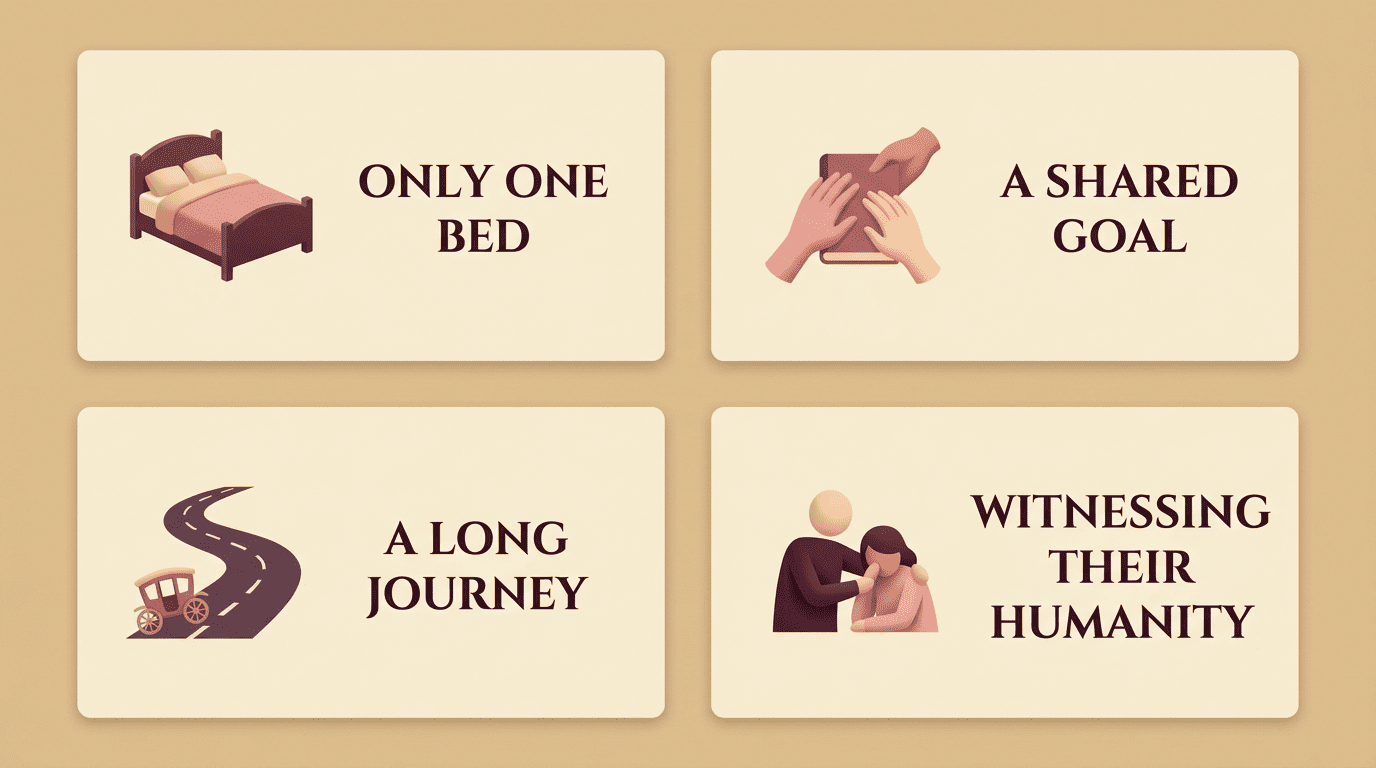
Reliable ways to force sustained contact between hostile characters include:
- Small revelations — moments where one accidentally learns something true and unguarded about the other
- A shared goal that makes cooperation temporarily necessary
- Extended boredom and conversation, such as a long drive, a stakeout, or a shared watch
- Witnessing the other’s humanity directly — seeing them grieve, protect someone, or fail
Classic devices like the «only one bed» trope or an unavoidable joint assignment work because they compress all four techniques into a single scene.
Keep the tension ambiguous
A charged scene works precisely because the reader isn’t sure how it will resolve — whether the moment tips into conflict or into intimacy. That ambiguity should not be rushed. This is also where tasteful craft matters most: build the growing attraction through suggestion — a held glance, an unfinished sentence, an «almost» moment — rather than a fully explicit scene. The tension the story has been building is the payoff; resolving it too soon or too graphically undercuts it.
A practical test while drafting: if a charged scene could just as easily end in an argument as in a kiss, it’s doing its job. If the outcome feels inevitable the moment the scene begins, the ambiguity — and the tension along with it — has already collapsed.
Vulnerability and Character Growth
The moment a reader stops seeing one character purely as an obstacle to the other is usually a moment of real vulnerability.
Show the soft underbelly
A single unguarded scene — fear, grief, or a quiet need for comfort — can flip the reader’s read on a character entirely. The American Psychological Association’s overview of relationships notes that emotional closeness tends to deepen when people let their guard down with one another — which is exactly the mechanism enemies-to-lovers stories are built on.
The scene doesn’t need to be large. A single line where a guarded character admits fear, or a moment they don’t realize they’re being watched, can do more to humanize them than an entire backstory chapter delivered through exposition.
Let both characters change
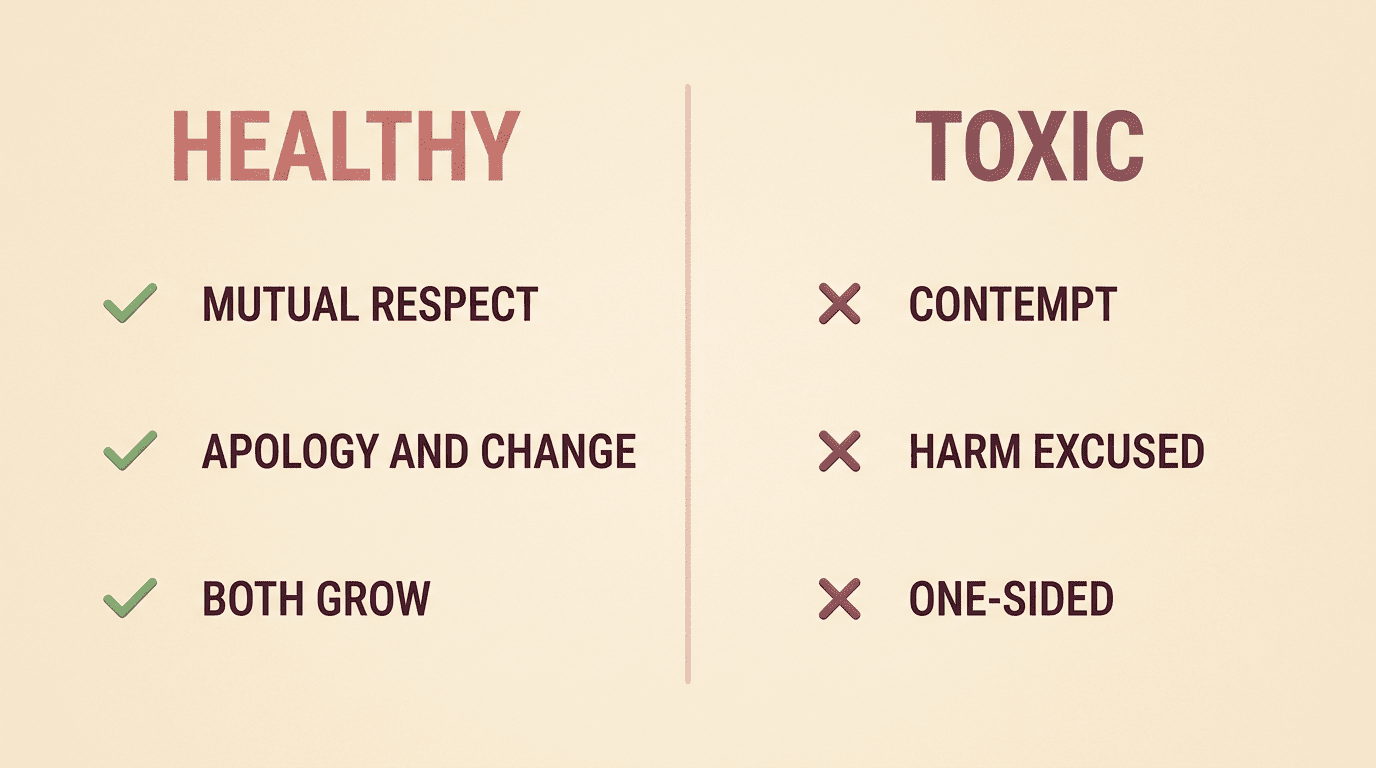
Growth has to run in both directions. If only one character does the emotional work while the other stays static and simply gets «won over,» the arc reads as one-sided and can unintentionally romanticize an unhealthy dynamic — one person as rescuer, the other as project. Iron should sharpen iron: each character should leave the story changed by the other.
A useful check while drafting is to list what each character believed at the start of the book and what they believe by the end. If only one list changed, the growth is one-sided, and the arc needs rebalancing before the ending will land.
Keep It Healthy, Not Toxic
The trope only works if hostility reads as conflict, not cruelty.
Conflict, not cruelty
Resistance, sharp dialogue, and real disagreement are the engine of the trope. Bullying, humiliation, or contempt dressed up as banter are not. As Jane Austen’s Pride and Prejudice shows more than two centuries later, the pull of the trope has never depended on cruelty — it depends on two people who misjudge each other and then have the honesty to admit it. Darcy’s first proposal is proof that timing matters as much as the feeling behind it:
You must allow me to tell you how ardently I admire and love you.
Mr. Darcy, in Jane Austen’s Pride and Prejudice
Elizabeth refuses him on the spot. The line doesn’t land — because at that point in the book, both Darcy and Elizabeth are still genuinely wrong about each other, and a declaration made before that gets resolved reads as premature rather than earned. It takes a rejected proposal, a letter, and months of changed behavior before either of them is ready to say it again.
Repair and consequences
Real hurt in the backstory has to lead somewhere: an apology, a visible change in behavior, and consequences that actually cost the character something. A love interest should acknowledge real wrongdoing before the relationship resolves, and backstory should explain the harm without excusing it.
| Healthy Pattern | Toxic Pattern |
|---|---|
| Sharp disagreement over real issues | Contempt, mockery, or humiliation |
| Apology and visible behavior change | Harm excused by backstory alone |
| Both characters keep their autonomy | One character reshapes themselves entirely for the other |
| Growth happens on both sides | One character «fixes» or «tames» the other |
The size of the repair should roughly match the size of the original harm. A minor slight can be resolved with a small gesture, while a real betrayal needs sustained, visible change across multiple scenes — not a single apology scene that wraps everything up too neatly.
Handling Intimacy Tastefully
The real payoff of enemies to lovers is emotional, not physical. The climax of the arc is the moment the characters’ defenses finally drop and the feelings they’ve both been denying get said out loud. That moment carries the weight of everything the story built to get there — which is why an emotional beat, handled well, often lands harder than an explicit one.
Suggestion and restraint are craft techniques, not compromises. A handful of reliable techniques keep an intimate scene tasteful without losing its emotional weight:
- Closing the door on a scene right at its emotional peak
- Cutting away to a meaningful detail or gesture instead of describing the act
- Staying focused on emotion and dialogue rather than anatomy
- Letting the scene resume afterward, with the closeness implied rather than shown
A well-placed ai fiction writing tool can help test exactly where a fade-to-black should land so the emotional beat still reads as the climax of the arc, not an afterthought.
Learn From the Classics and Bestsellers
Studying how established books handle the arc makes the mechanics easier to apply to a new story.
Pride and Prejudice as the template
Austen’s Darcy and Elizabeth remain the reference point for the trope, and for good reason. Both characters are wrong about the other in specific, understandable ways; both grow through the course of the book; and Darcy’s change is proven through action — quietly repairing harm — rather than through a speech. For more on the novel’s structure and reception, see Britannica’s entry on Jane Austen.
Darcy never resolves the arc with a speech about his feelings. The letter he writes Elizabeth, and the quiet actions that follow it, do the persuading instead — a useful model for any writer tempted to resolve an arc through dialogue alone rather than through what a character actually does.
Modern bestsellers to study
Contemporary romance keeps the same bones. Sally Thorne’s office-rivals story The Hating Game runs the arc through workplace competition and constant banter. Julia Quinn’s The Viscount Who Loved Me, the basis for a season of Bridgerton, pushes Anthony and Kate through mutual suspicion toward a slow-burn partnership. Both keep the tension alive through dialogue and proximity long before either character admits what’s happening.
Both books also lean on a single shared setting — the office in The Hating Game, the London social season in The Viscount Who Loved Me — to keep forcing the leads into each other’s orbit without the plot needing to contrive new reasons for them to meet.
How an AI Romance Writing Assistant Can Help
Every stage above is a place where a romance writing ai can speed up the work without replacing a writer’s voice. It can help brainstorm specific, defensible reasons two characters would genuinely be at odds, draft a beat sheet for the six-stage arc, and generate multiple versions of a charged scene’s dialogue so a writer can pick the one with the right ambiguity. It’s also useful for checking pacing — flagging where a slow burn is moving too fast or stalling too long — and for testing fade-to-black transitions that keep intimacy tasteful without losing the emotional payoff.

Common ways a romance writing assistant supports this arc:
- Brainstorming a specific, meaningful cause of the initial conflict
- Building and adjusting a beat-by-beat outline of the six stages
- Drafting alternate versions of charged, ambiguous scenes
- Checking whether pacing reads as earned or rushed
- Suggesting tasteful fade-to-black transitions for intimate moments
The goal is always craft support for a tasteful, character-driven story — not a shortcut around the writing itself.