
How to Write Believable Characters Readers Fall For
A believable character isn’t the one you described the most — it’s the one who wants something specific, carries a wound that explains their fear, and behaves consistently even when the plot surprises them. If those three things are missing, no amount of physical description will make a reader care, whether you’re drafting longhand or pressure-testing scenes with an ai romance writing assistant.

This guide breaks that down into seven working parts — goal, motivation, wound, flaw, conflict, arc, and voice — and then applies the same framework to the hardest character in any love story to get right: the love interest a reader actually falls for.
What Makes a Character Believable (Not Just Realistic)
Readers often reach for «realistic» when they mean something narrower and more useful: internally consistent. A character can do things no real person would ever do — outrun an avalanche, run a smuggling ring, fall in love in three days — and still feel completely believable, as long as their choices track back to a clear inner logic.
Believable does not mean realistic. As Wikipedia’s entry on characterization lays out, a character is built from the traits an author reveals through action, speech, and appearance — and a character can be larger than life, funnier, braver, or more stubborn than anyone you’d meet in person, provided their behavior stays consistent with who they’ve already shown themselves to be. A protagonist who solves every problem by punching it can be entirely believable inside an action story; the same protagonist suddenly negotiating a peace treaty with no setup would break the reader’s trust, not because it’s unrealistic, but because it’s inconsistent.
That consistency rule is only half the picture. The other half is a strange fact about specificity: the more particular a character’s want, the more universal the reader’s response to it tends to be. «She wants to be happy» describes nobody; «she wants to win back the bakery her grandmother lost in a card game» describes one very particular person — and, paradoxically, gives far more readers something to attach to. Vague, general traits read as filler; a single concrete, telling detail (the ex-cop who still counts exits in every room he enters) does the work of three paragraphs of description.
Give Every Character a Goal, Motivation, and Conflict (GMC)
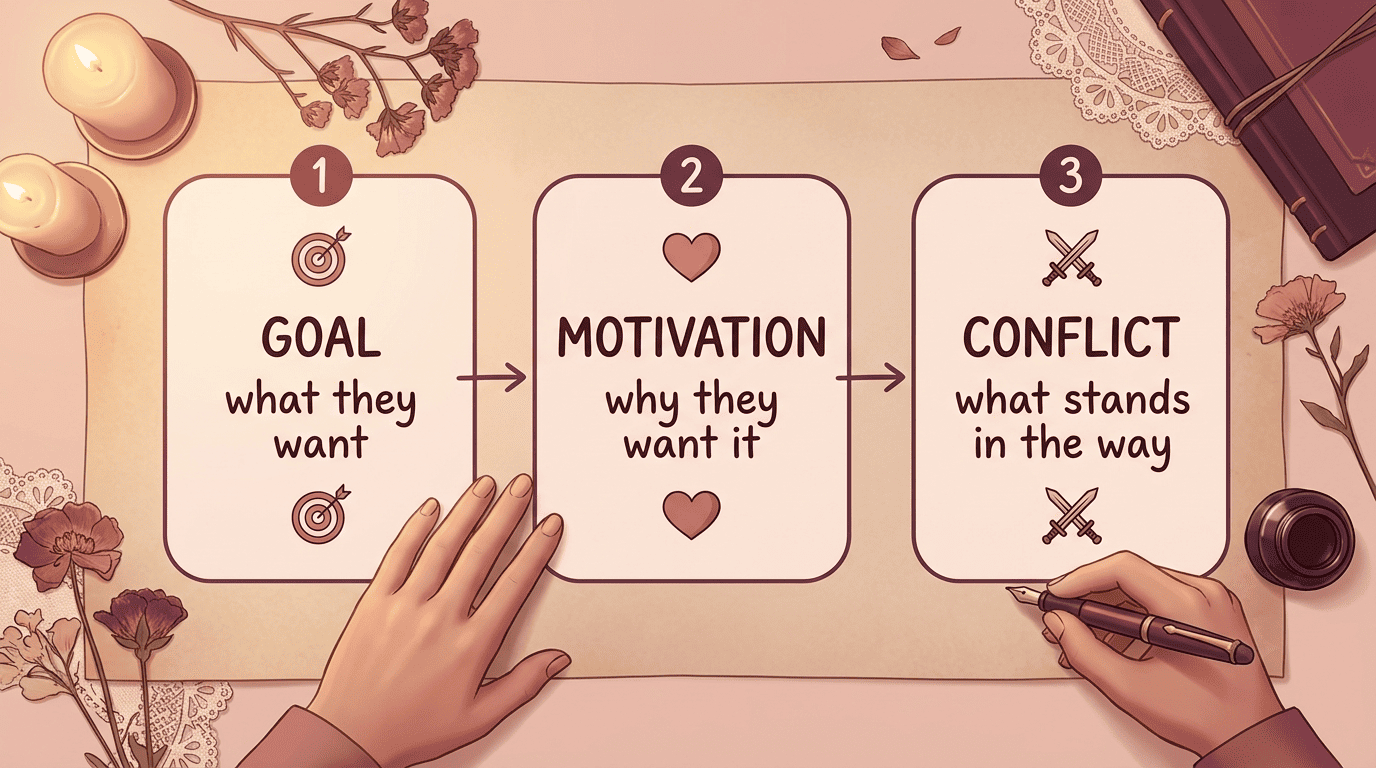
Romance author Debra Dixon’s GMC framework — goal, motivation, conflict — is one of the most durable tools in character craft, and it works the same way for a protagonist, a villain, or a supporting best friend. Goal is what the character wants, motivation is why they want it, and conflict is what’s stopping them. Strip any one leg out and the character stalls.
| GMC element | Question it answers | Example |
|---|---|---|
| Goal | What does the character want? | Win back the family bakery |
| Motivation | Why do they want it? | It’s the last thing tying them to a grandmother they lost |
| Conflict | What’s stopping them? | A rival buyer with more capital and no sentiment |
What they want (goal)
Every character needs to want something in every scene, not just across the whole book. As novelist Kurt Vonnegut put it:
Every character should want something, even if it is only a glass of water.
Kurt Vonnegut, Bagombo Snuff Box
That «glass of water» line is really a warning against passive scenes: a character sitting and reflecting, wanting nothing, is a character the reader can skim past. A story goal (win the case, get home, win her back) sits above dozens of smaller scene goals (get through this dinner without lying, get the witness to talk), and it’s the scene goals that keep pages turning.
Why they want it (motivation)
Motivation is the why underneath the goal, and it usually traces back to backstory. A handful of core motivations show up again and again across genre fiction:
- Love — belonging, protecting, or winning someone back
- Wealth or status — security, or escaping a past defined by lacking both
- Redemption — atoning for a real mistake the character can’t undo
- A better world — fixing something broken for people other than themselves
A villain chasing wealth out of simple greed is flat; a villain chasing wealth to buy back a childhood home the family lost is understandable, even if the reader still roots against them. Motivation is what turns «the antagonist» into a person with a case for their own choices.
What stands in the way (conflict)
Conflict splits into two layers that should reinforce each other: internal conflict (fear, self-doubt, the wound described below) and external conflict (an antagonist, a deadline, a rival, circumstance). The conflict has to be tailored to that specific character — the same external obstacle lands completely differently depending on what a character already fears.
Build a Backstory and a Wound (Show Only a Fraction)
Backstory is the deepest well a writer draws from, but almost none of it should appear on the page directly — it should show up as behavior. MasterClass’s guide to character backstory frames it the same way: backstory exists to inform present-day choices, not to be recited. Charles Dickens’ own childhood working in a blacking factory as a boy fed directly into the hardship and resilience of characters across his novels; he never had to explain that history in the text for readers to feel its weight in how those characters moved through the world.
The wound behind the want
The wound is the specific past hurt that explains why a character fears what they fear and avoids what they avoid. It’s the mechanism that connects backstory to present-day behavior: a character who was abandoned as a child doesn’t need a label that says «fears abandonment» — she just needs to flinch, every time, at the moment someone she loves reaches for the door. In romance especially, the wound is gold: it’s usually the exact thing standing between a character and the one person who could heal it.
Write more than you show
A common piece of advice among craft teachers is to invent far more backstory than will ever appear on the page — write the whole history for yourself, then let only the fraction that shapes present behavior surface in the story. Readers don’t need the full case file; they need the one detail that explains the flinch.
Flaws, Contradictions, and Consistency
No person in life is without a flaw, and a character who is reads as a character nobody believes. Even a figure built to be nearly invincible needs a Kryptonite — a specific vulnerability that costs them something whenever the plot presses on it.
| Flaw type | What it does | Example |
|---|---|---|
| Cute quirk | Adds color, costs nothing | Always orders the same coffee |
| Meaningful flaw | Actively sabotages the character’s goal | Can’t trust anyone, so she pushes away the one ally who could help her win |
| Fatal flaw | Threatens to end the character’s arc entirely | Pride that costs the hero the one relationship he needed most |
Meaningful flaws (not cute quirks)
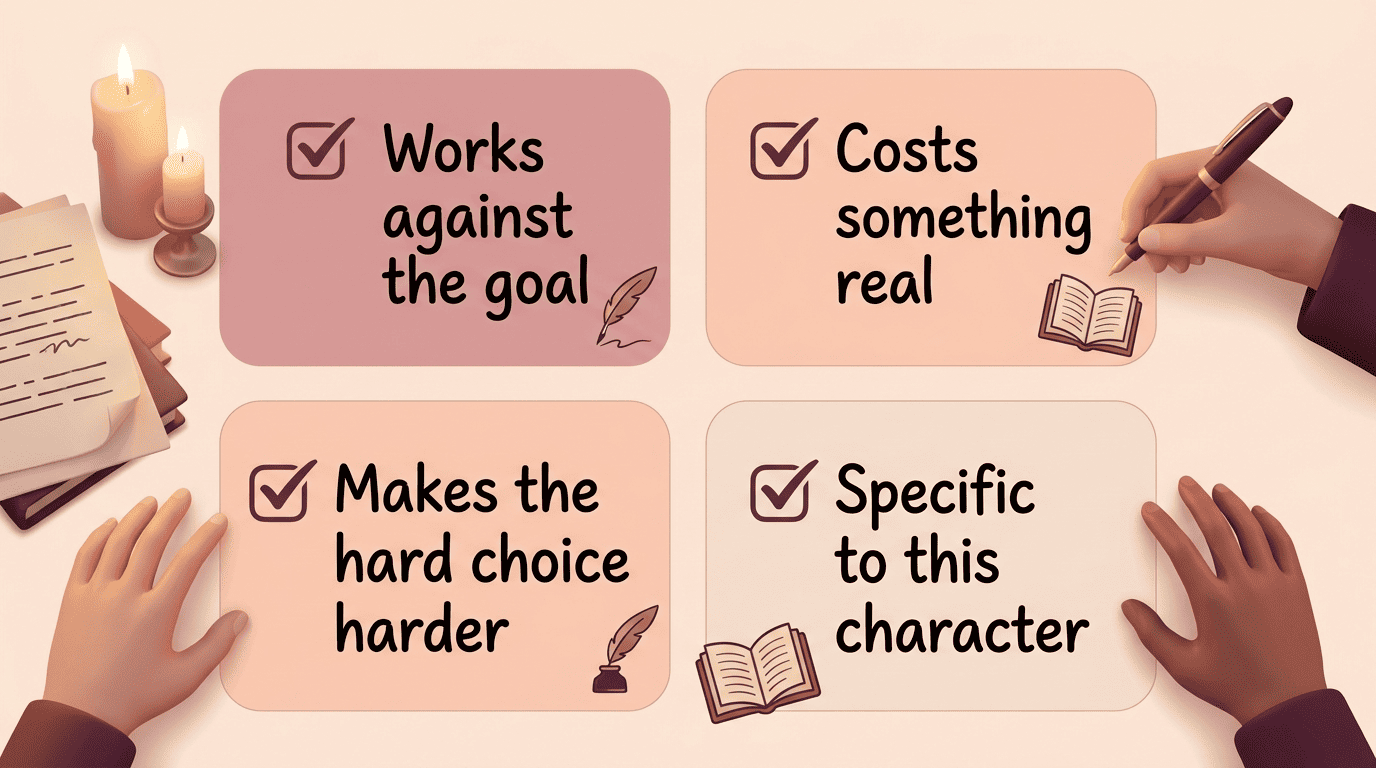
A flaw earns its place when it makes the plot harder, not when it just makes the character quirky. Writers should also resist pushing a character to either extreme — a character who is 100% good or 100% bad reads as a caricature, not a person, because real motivation always has some self-interest tangled inside the noblest choice. Before locking a flaw in, it helps to check it against a short list:
- Does the flaw actively work against the character’s stated goal, not just their mood?
- Does acting on the flaw cost the character something real at least once in the story?
- Would removing the flaw make the character’s hardest choice easier?
- Is the flaw specific to this character, or could it belong to anyone?
If a flaw fails all four questions, it’s decoration, not craft.
Contradictions make them human
In The Art of Character, novelist David Corbett argues that desire, frustration, vulnerability, and contradiction are what make a character feel alive on the page — not polish. A hardened detective who breaks down over an injured stray dog is more believable than one who’s tough in every single scene, because the contradiction shows the reader there’s a person underneath the armor.
Consistency and the «logical surprise»
A believable character behaves consistently, scene after scene — and when they do something unexpected, the surprise has to be logical in hindsight, built from evidence the reader already has. An out-of-character choice that arrives with no setup doesn’t feel like growth; it feels like the writer needed the plot to move and borrowed the character to do it.
Show Character Through Action, Dialogue, and Voice
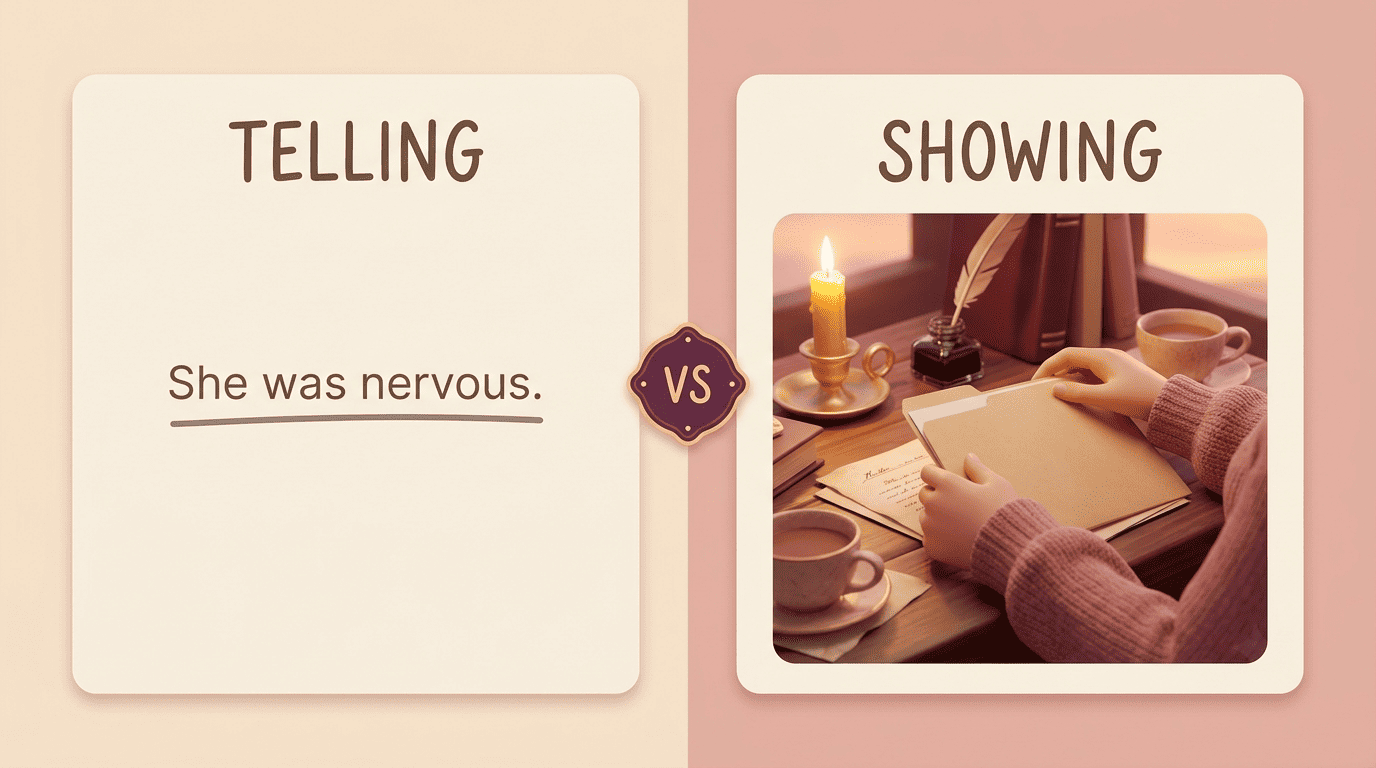
Readers trust behavior over description. Telling a reader «she was fiercely independent» asks for faith; showing her turn down help twice in a row, even when it costs her, earns it. Stieg Larsson’s Lisbeth Salander is revealed almost entirely through what she does under pressure rather than through exposition about her past — and that’s exactly why she reads as so distinct.
Here’s a quick before-and-after of the same beat handled both ways:
- Telling: «Marcus was nervous about the interview.»
- Showing: Marcus straightened the same folder three times, then left it crooked on purpose so he’d have something to fix while he waited.
Show, don’t tell
The instinct to explain a character’s feelings directly is understandable — it’s faster — but it also does the reader’s job for them. As the Reedsy blog on showing vs. telling puts it, showing trusts the reader to do the emotional math themselves. Trust the reader to infer nervousness, jealousy, or hope from a specific physical choice, and the moment lands harder than any adjective could.
A distinct voice for each character
Give every character their own vocabulary, rhythm, and — just as important — their own silences: what a character refuses to say often reveals as much as what they do say. A useful test is to cover the character names in a page of dialogue; if you still know who’s speaking from word choice and rhythm alone, the voices are doing their job.
Let Them Change: The Character Arc
Not every character needs to transform — but a protagonist who ends the book exactly as they began it usually feels flat, because static characters read as scenery rather than people the story happened to.
Separate the want from the need. The classic arc separates what a character consciously chases (the want) from what they actually need to become whole (the need) — and the two are often in tension for most of the book. A character wants the promotion; what she actually needs is to stop measuring her worth by other people’s approval. The arc is usually a direct answer to the wound: either the character heals it, or the story shows the cost of never facing it.
Let supporting characters stay static, on purpose. Not every character in the cast needs a full transformation. Supporting characters can work well as foils — steady points of comparison that throw the protagonist’s change into relief precisely by staying the same, giving the reader a fixed point to measure the protagonist’s change against.
Move the protagonist, always. The character carrying the story does need to change, because a protagonist who’s identical on the last page and the first page gives the reader nothing to have followed them for. Even a small, hard-won shift — trusting one person after a book of trusting no one — is enough to make the ending feel earned.
Writing a Believable Love Interest (Chemistry That Feels Earned)
A love interest built only from physical description — tall, brooding, a great laugh — is a mannequin, not a match for the reader’s protagonist. The same goal-motivation-wound framework that builds any believable character is what makes a love interest someone worth rooting for.
Give the love interest their own goal and wound
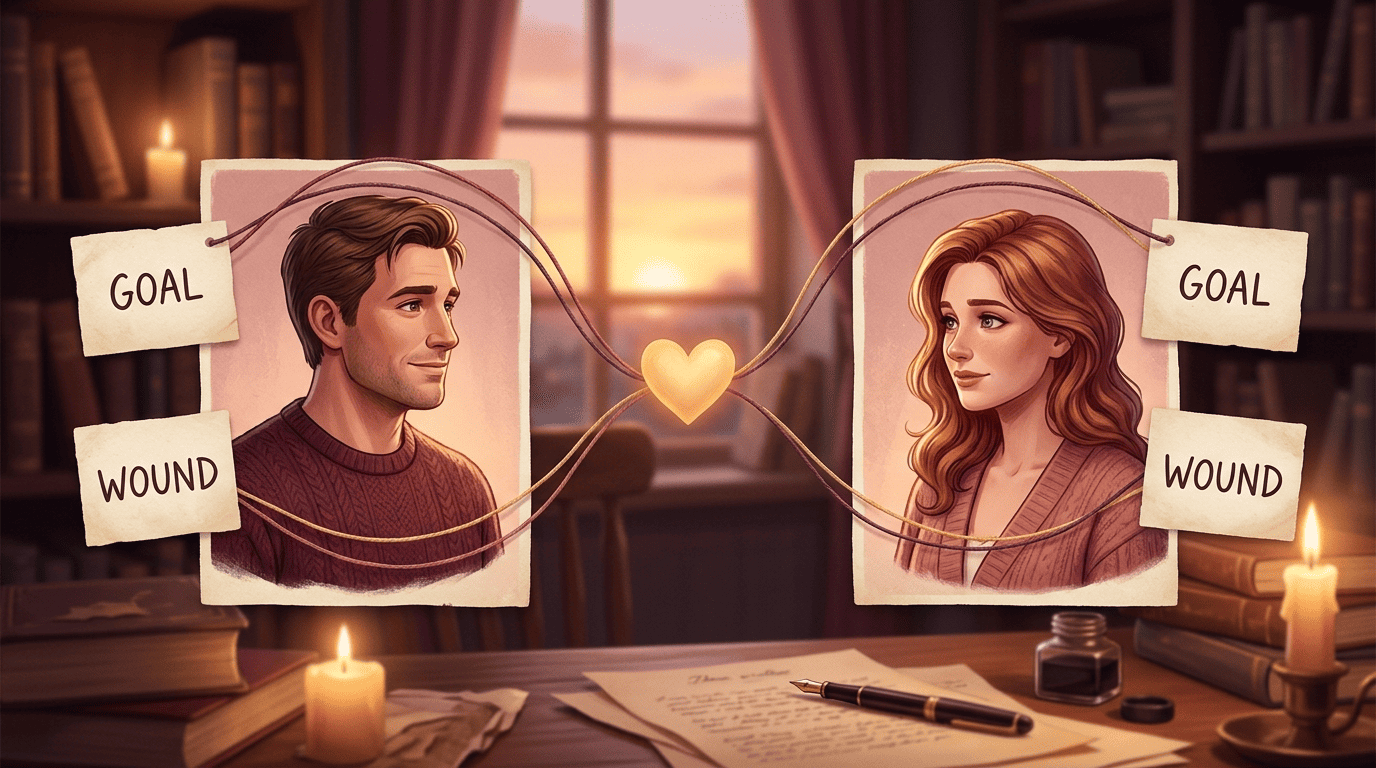
A love interest isn’t a prize waiting at the end of the plot; they need a story of their own, running in parallel, with a goal the protagonist doesn’t control and a wound the protagonist can’t fix by simply showing up. Chemistry is what happens when two fully formed people — two wants, two wounds — collide, each one changing what the other is willing to risk. This is exactly the kind of structural work an ai fiction writing tool can help stress-test: does the love interest have a goal that exists independent of the romance, or do they only show up when the protagonist needs them?
Chemistry is conflict + vulnerability, not description
On the page, attraction is best shown through reaction — a held glance, a joke that lands too well, a small concession neither character planned to make — rather than through a catalog of features. Tropes like slow burn and enemies-to-lovers earn their heat specifically because both characters walk in with something to protect and something to lose; take away either character’s internal stakes and the trope collapses into two people who simply like each other. Keep the intimacy tasteful: the charge comes from emotional risk and vulnerability, not from graphic description, and that restraint is usually what makes a scene feel earned rather than gratuitous.
A Simple Character Interview and Profile
A character interview is one of the fastest ways to surface backstory, fears, and desires you didn’t know your character had until you asked directly.
Interview your character
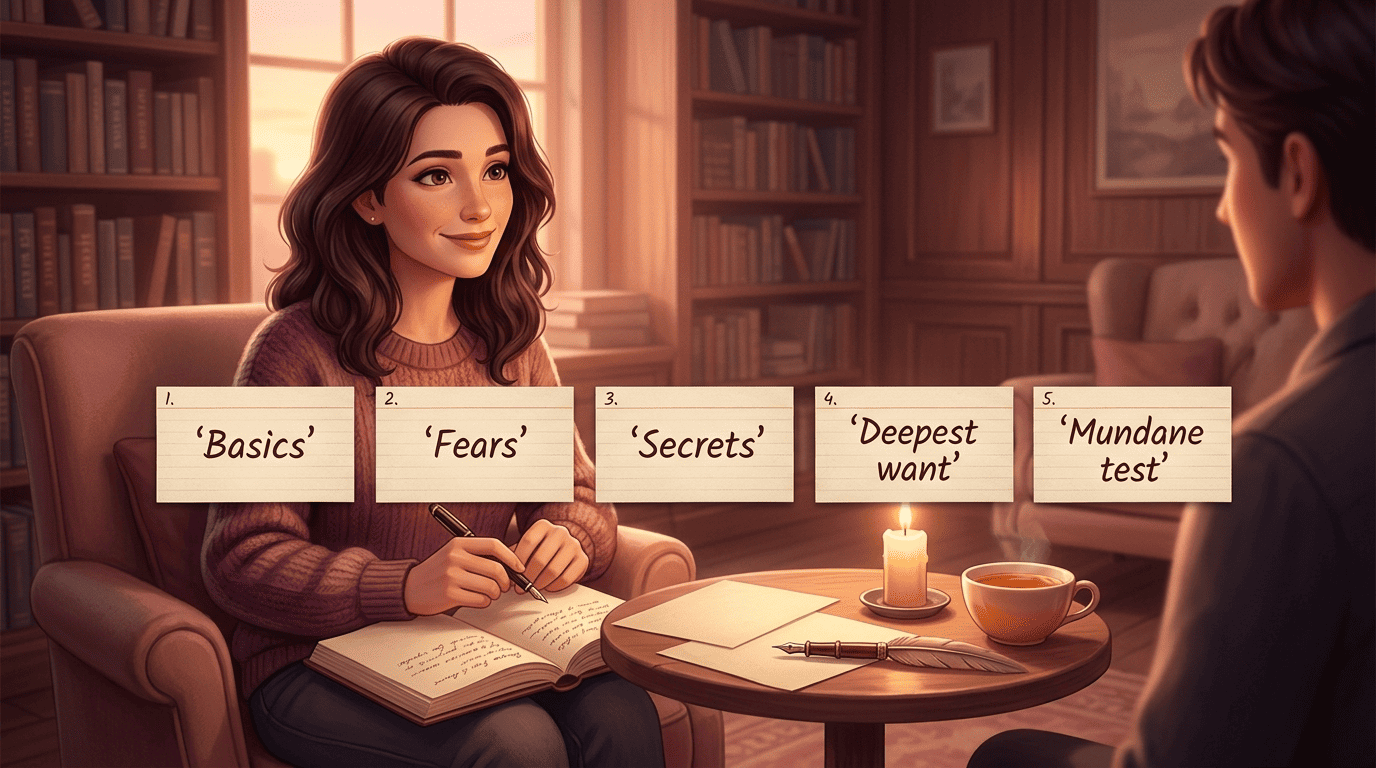
Some writers sit down and interview a character for thirty minutes or more, keeping a character diary in the character’s own voice for a week afterward to see how consistently that voice holds. A simple five-step version of the interview looks like this:
- Write down the basics — name, age, occupation, the surface facts anyone would know.
- Ask what they’re afraid of, and don’t accept the first answer; push for the specific version of the fear.
- Ask what they’re hiding — from other characters, and from themselves.
- Ask what they want more than anything else, separate from the plot’s stated goal.
- Put them in a small, low-stakes decision (what they order, what they carry in their bag) and see if the answer feels consistent with everything above.
A useful starter list for step three covers the harder questions directly:
- What’s the character’s biggest secret, and who would be hurt most if it came out?
- What do they carry in their pockets or their bag, and why does it matter to them?
- What would they never admit out loud, even under direct pressure?
Answers here tend to surface the wound faster than any amount of outlining.
The mundane-scene test
Drop the character into a scene with nothing at stake — waiting in a checkout line, standing in an elevator — and see whether they’re still interesting with no plot pushing them forward. If a character only comes alive during car chases and confessions, the character isn’t carrying the story; the plot is. This is also the moment to slip in a quieter version of the same tool: run the scene through a romance writing ai as a low-stakes sandbox, and watch whether the character’s voice and wants still hold up when nothing dramatic is happening.