
How to Write a Love Story: A Step-by-Step Guide to Romance That Readers Feel
A great love story isn’t about two people falling in love — it’s about two people readers can’t stop rooting for. Working with a romance writing ai can help you test whether a scene earns that reaction, but the craft itself comes down to a simple answer: write a love story by building flawed characters who want each other, then keep them apart with real obstacles until an earned happy ending.

This guide walks through the core elements, the three-act structure and beats, how to build romantic tension through a slow burn, using tropes without falling into cliché, the dark moment, and how to land an HEA or HFN ending that readers actually believe.
What Actually Makes a Love Story Work
Romance is the best-selling fiction genre in the world, yet most attempts at a love story fall flat for the same reason: the writer chases plot before feeling. A love story only works when the reader senses a real emotional connection between two specific, flawed people — not a generic pairing of «hero» and «love interest.» That connection is what compelling flawed characters exist to deliver.
Writing a love story isn’t just about romantic relationships. Rather, it’s about exploring the deep emotional connections that define us.
Gila Green
The one non-negotiable: emotional truth
Readers can tell when a relationship is performing happiness instead of earning it. A romance written entirely in one emotional register — sweet, easy, conflict-free — reads as false, because that isn’t how real intimacy works. Love in fiction has to carry the same complexity as love off the page: doubt alongside desire, friction alongside comfort. The craft principle here is that real love is hotter love — the more honestly a writer renders the messy, contradictory feelings underneath attraction, the deeper the romance lands.
Love as connection, not just attraction
Green’s point above matters because it reframes what a «love story» even is. It isn’t only the boy-meets-girl plotline; it’s the exploration of the emotional connections that define a character. That’s true even in books where romance is a subplot rather than the main event — the wound one character exposes to another, the vulnerability that gets rewarded or punished, is the actual engine of the story, regardless of genre label.
Start With Characters Worth Falling For
Before any plot mechanics, a love story needs two people worth rooting for — individually, not just as a pair. Fully formed, flawed characters do a huge amount of the narrative work for a writer, because their contradictions generate conflict on their own, without the plot having to manufacture it.
Give each lead a wound and a false belief
Every convincing romantic lead enters the story carrying an emotional wound and a false belief about love that grew out of it — «I don’t deserve love,» or «letting my guard down means getting hurt.» That wound is what makes falling in love feel risky rather than convenient, and risk is what gives a romance its stakes. A dark-moment internal line like «I knew better than to believe in love, because when I let my guard down, this is what happens» only lands if the reader has watched that false belief operating since the opening chapters.
A goal beyond the romance
A character also needs a goal beyond the romance itself — a job to save, a family to reconcile with, a case to win. Without one, the love interest becomes the character’s entire reason for existing, which flattens them into a prop. As one romance-craft framework puts it, don’t make romance your protagonist’s whole world; make it part of their world. That outside goal is also where useful conflict comes from, since the love interest will inevitably complicate it.
Chemistry is built, not declared
Chemistry isn’t a line of narration announcing that two characters feel a spark — it’s built from a handful of concrete ingredients:
- Shared values that surface naturally in how each character makes decisions.
- A believable partnership, where the leads are genuinely useful to each other beyond attraction.
- An ill-suited pairing that generates humor and friction rather than easy agreement.
- Flaws that read as sexy rather than merely realistic — imperfection that makes a character feel like a person worth wanting.
For deeper craft resources on shaping character flaws into chemistry, Reedsy’s guide to character development is a solid reference.
Structure: The Beats of a Love Story
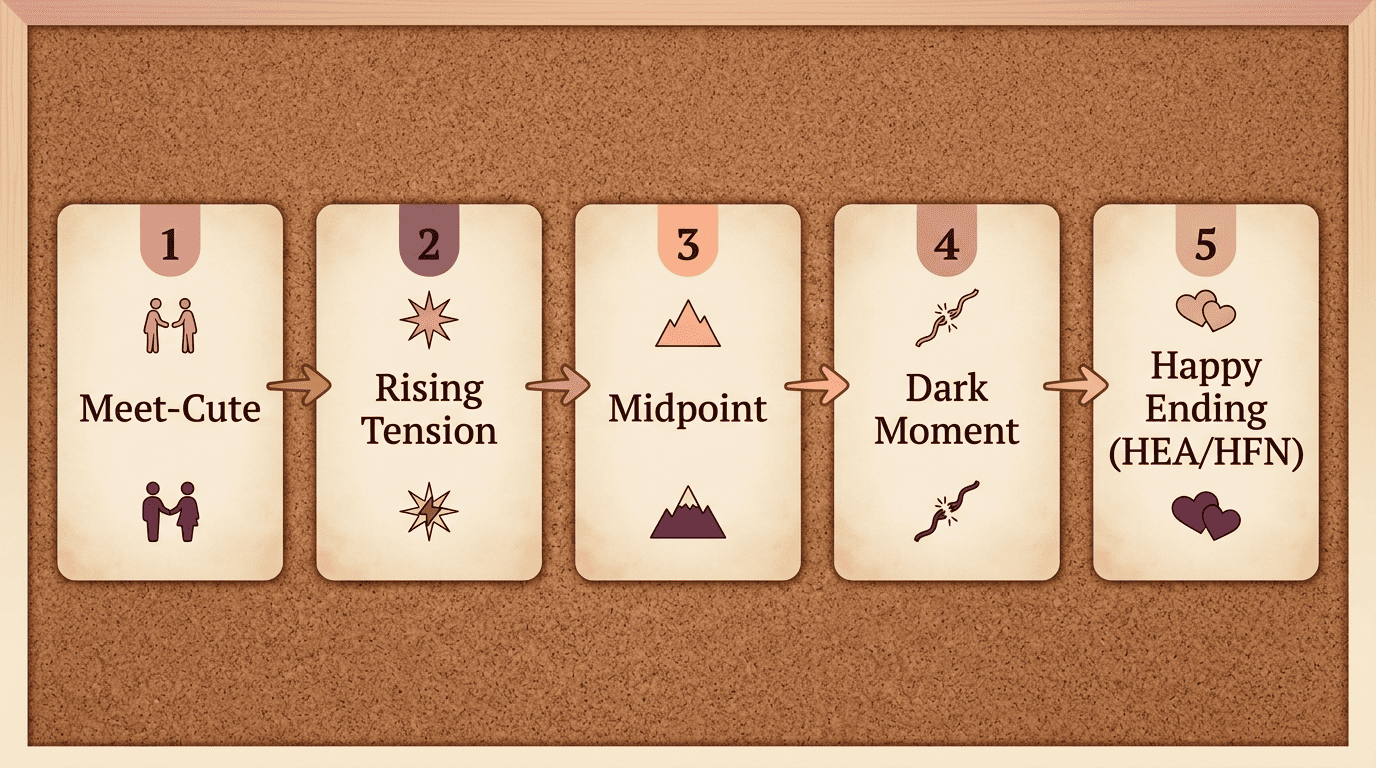
Once the characters exist, a love story needs a shape. Most romance novels — regardless of subgenre — follow a version of the three-act structure, with the meet-cute functioning as the story’s inciting incident.
The three-act backbone
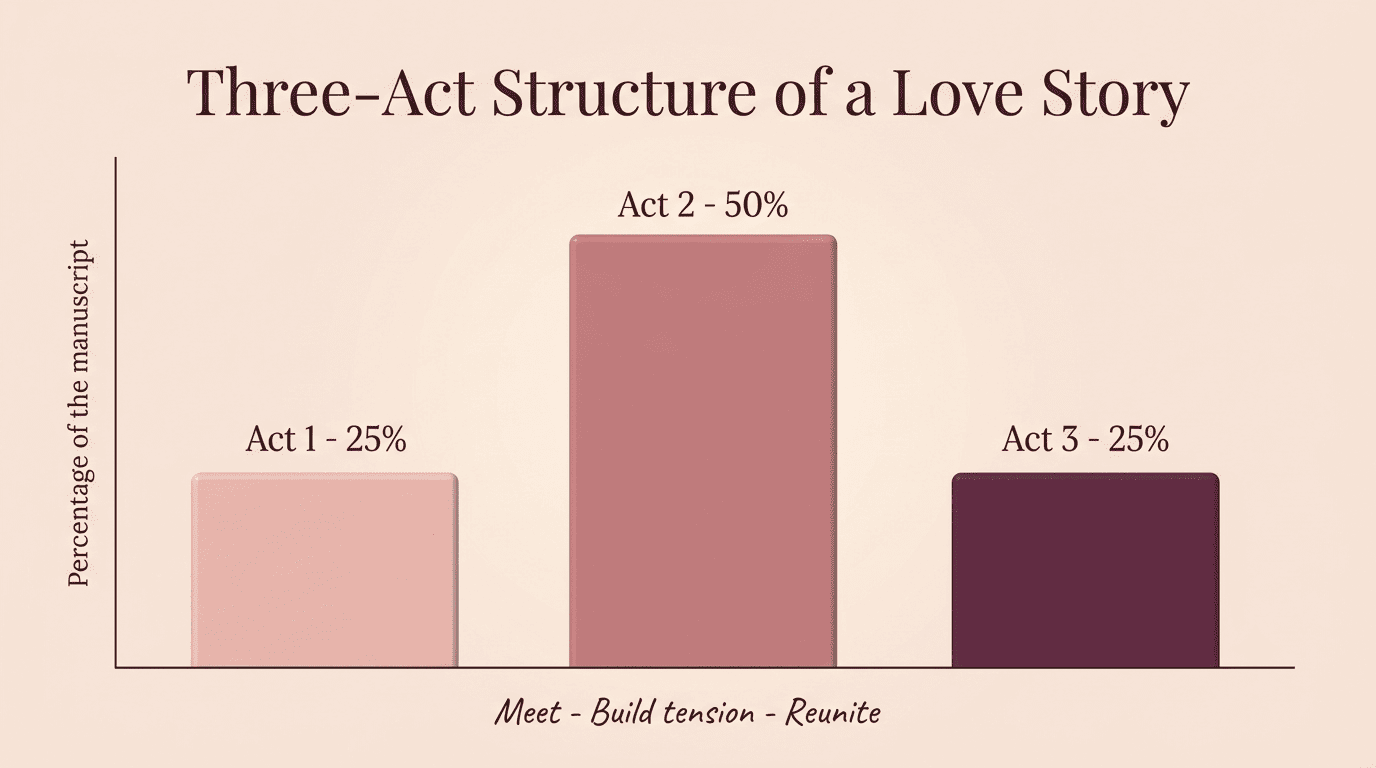
Act 1 (roughly 25% of the book) covers the meeting and initial pull between the leads. Act 2 (roughly 50%) escalates both intimacy and obstacles, building toward the point of maximum closeness. Act 3 (roughly 25%) delivers the rupture and the reconciliation. On an 80,000-word manuscript, that maps to roughly 20,000 words for Act 1, 40,000 for Act 2, and 20,000 for Act 3.
Key beats and where they land
A useful way to plan is to place the major beats against a percentage of the manuscript, then check pacing against it as you draft:
| Beat | Approximate position | Function |
|---|---|---|
| Hook | ~1% | Establishes the protagonist’s world and false belief |
| Inciting incident / meet-cute | ~12% | The leads meet — this is always the inciting incident in a love story |
| First plot point | ~25% | The relationship becomes unavoidable |
| Midpoint | ~50% | Peak intimacy or a false victory |
| Crisis / dark moment | ~88% | The relationship appears to fail |
| Climax | ~90% | The grand gesture or turning point |
| Resolution | ~98% | HEA or HFN |
Other frameworks work too — a ten-beat romance sheet or a four-part model both hit the same emotional checkpoints with different labels. What matters more than the exact scaffolding is the constant: the inciting incident is always the moment the two leads meet.
Build Romantic Tension (The Slow Burn)
Romantic tension is what keeps a reader turning pages between the meet-cute and the payoff. It comes from a combination of obstacles and longing, and the bigger the obstacle, the more satisfying the eventual release.
Tension = obstacles + longing
Conflict in a love story doesn’t require the leads to be adversaries. Two people can like each other enormously and still want incompatible things — one needs to leave town, the other needs to stay; one is guarded, the other is reckless with their feelings. That mismatch, not manufactured hostility, is usually what produces the most believable tension.
Anyone who really knows me would happily tell you that patience is not a virtue I possess. And yet, patience is key when writing a slow burn romance.
Falon Ballard, Writer’s Digest
The five levers of slow burn
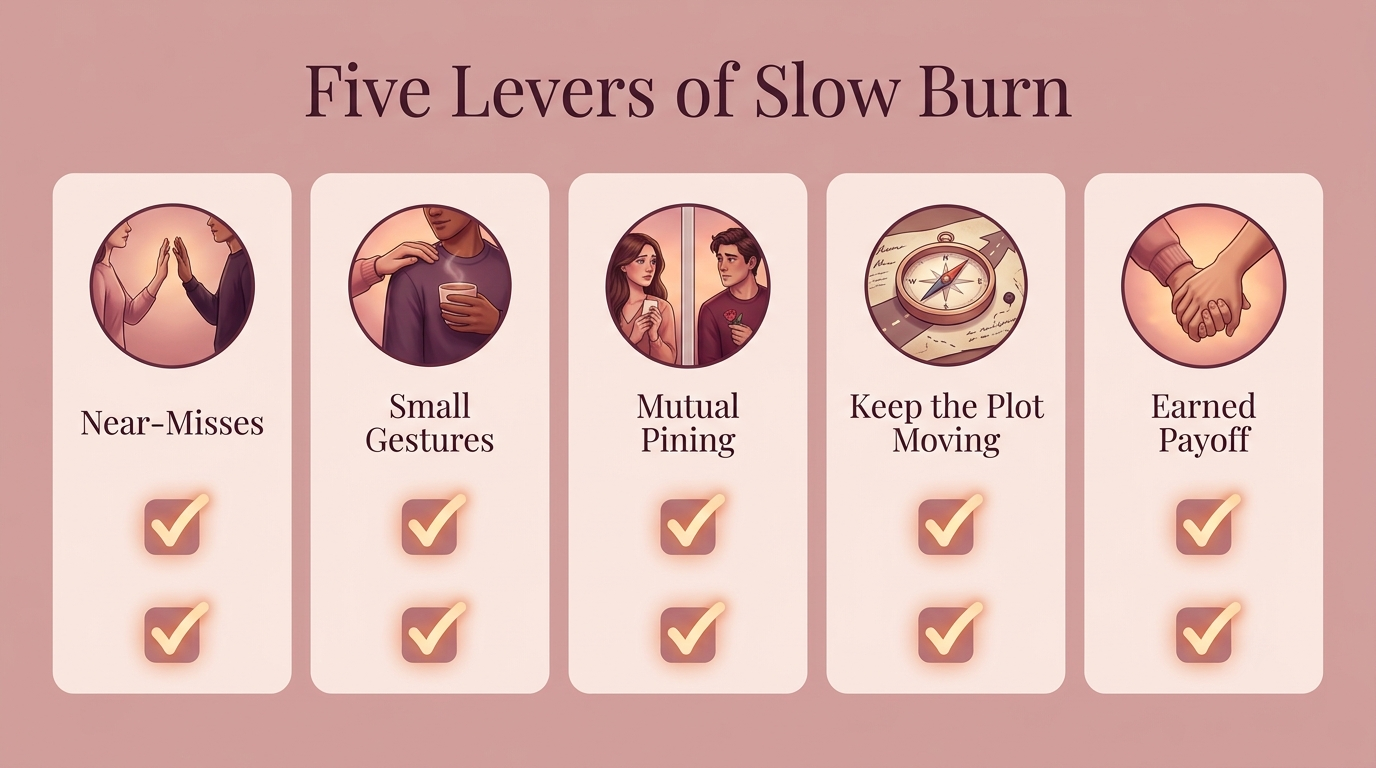
Writer’s Digest breaks slow burn into five practical tools, and they hold up across subgenres:
- Near-misses. An almost-kiss interrupted by a phone call, a hug that lasts a few seconds too long — small ruptures that keep the tension alive.
- Small physical details. A brush of fingers, a lingering glance, a wink — these carry more weight than a declaration ever could.
- Pining from both sides. Readers need to feel longing from both leads, even in single-POV narration, conveyed through actions and internal thought rather than statements.
- Slow burn, not slow pace. The romance builds slowly, but the plot keeps moving — other conflicts and situations should occupy the characters while the tension simmers.
- A payoff that’s worth the wait. When the release finally comes, it has to be rendered in full, unhurried detail — it’s what the whole story has been building toward.
The hand-flex scene in the 2005 film adaptation of Pride and Prejudice is often cited as the textbook example: a single, wordless physical gesture that lands harder than pages of dialogue because of everything withheld before it.
Use Tropes Without Falling Into Cliché
Romance tropes — enemies-to-lovers, fake dating, best-friends-to-lovers, star-crossed lovers — exist because they work. A trope gives the reader a structural promise up front: this is the shape of story you’re about to get, and this is the payoff you can expect. Far from being a shortcut, a trope is scaffolding — it tells the reader what kind of tension to expect and frees the writer from having to invent structure from scratch.
Enemies-to-lovers puts rivals who can’t stop noticing each other despite genuine friction, and lets the antagonism itself generate chemistry.
Fake dating starts as a staged relationship and lets real feelings creep in through proximity the characters didn’t choose.
Best-friends-to-lovers surfaces attraction inside an already-trusted bond, which raises the stakes because the friendship itself is now at risk.
Star-crossed lovers keeps two people apart through circumstance rather than personality — family, distance, timing — so the obstacle isn’t a flaw in either character.
The risk isn’t using a trope — it’s using it lazily. A trope stays fresh through specificity of character and motivation, not through avoiding it altogether. The universal shape (two people forced together who resist, then fall) is meant to be embraced; what needs to be original is why these two specific people resist, and what precisely breaks that resistance down. Writers like Emily Henry and Beth O’Leary consistently work inside familiar tropes while making the execution feel distinctly their own.
The Dark Moment and a Satisfying Ending
Every love story needs a low point before the reunion — a scene where it looks like the relationship has genuinely failed.
The dark moment
The dark moment is often described as the story’s Dark Night of the Soul — the point where the relationship appears to genuinely fail. It usually takes one of a few recognizable forms:
- A breakup triggered by miscommunication or a broken promise.
- A secret from one character’s past coming to light.
- The character’s original false belief winning out over the hope the romance built.
This is where the wound established in Act 1 does its final work — the character reverts to the belief that love isn’t safe, right when it matters most. Without this low point, reconciliation has nothing to be earned against.
Earn the happy ending (HEA vs HFN)
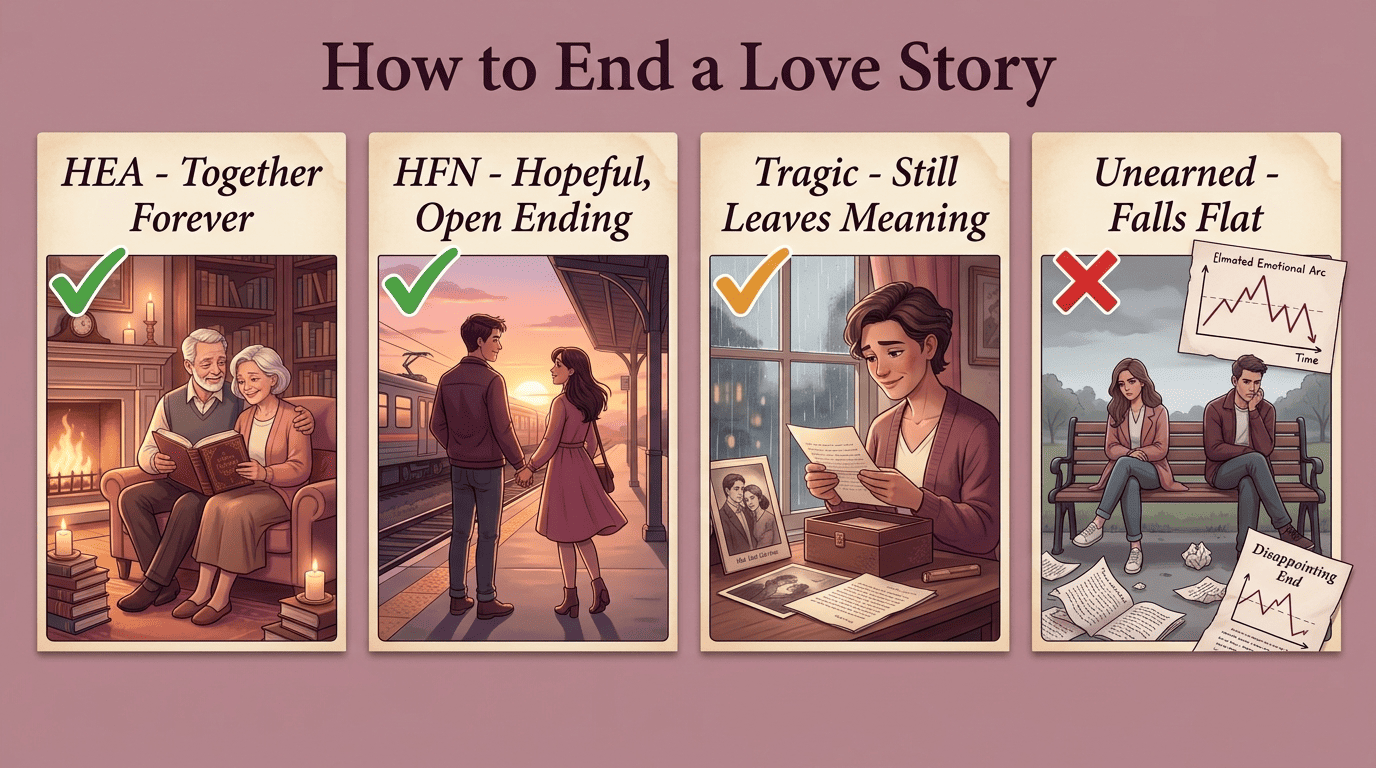
By genre definition, a romance has to end in either an HEA (happily ever after — the couple ends up together, permanently) or an HFN (happy for now — an optimistic but open-ended close). A story without one of these two outcomes isn’t classified as romance, regardless of how much romantic content it contains. What separates a satisfying ending from a cheap one is that it has to be earned — paid for by the wound and the dark moment that preceded it, not handed to the characters for free. A love story outside the romance genre can end tragically, but even then it should leave the reader with some form of hope or meaning, not just loss.
Below is a quick way to check whether an ending is doing its job:
| Ending type | What happens | Genre requirement |
|---|---|---|
| HEA | Couple commits permanently, future is settled | Satisfies romance genre convention |
| HFN | Couple is together and hopeful, future left open | Also satisfies romance genre convention |
| Tragic (non-romance) | Loss or separation | Must still leave meaning or hope |
| Unearned happy ending | Resolution with no real cost paid | Reads as unsatisfying regardless of genre |
According to the Romance Writers of America, a romance novel is defined by two elements: a central love story and an emotionally satisfying, optimistic ending — which is exactly why HEA and HFN aren’t optional extras, they’re the genre contract.
Writing Intimacy Tastefully
Intimacy in a love story is a craft choice, not an obligation to write anything explicit. The first kiss, or the first real moment of physical closeness, has to pay off everything the slow burn built. That doesn’t mean graphic detail — it means giving the moment enough space on the page to register as significant, and letting the emotion inside it, not the choreography, carry the weight.
«Fade to black» is a deliberate technique, not a shortcut around discomfort: the scene closes before anything explicit, and what the reader carries forward is the emotional shift between the two characters rather than physical description. Handled well, emotional intimacy — a confession, a moment of unguarded vulnerability — often hits harder than an explicit scene ever could.
This is also where an ai fiction writing tool can be genuinely useful for a writer: testing whether a scene reads as tender and earned, or as rushed, without needing to write anything beyond what the story calls for. The tone here is entirely a writer’s choice — the craft goal is emotional payoff, not explicit content.
How to Actually Start (and Common Mistakes)
Most writers stall on a love story not because the plot is hard, but because they start with tropes instead of people.
A simple starting workflow
- Get to know your leads first — their wound, their false belief, and a goal that exists independently of the romance.
- Pick the trope or promise that frames the reader’s expectations (enemies-to-lovers, fake dating, and so on).
- Sketch the beats across a three-act shape, even loosely — meeting, escalation, dark moment, resolution.
- Choose an obstacle that justifies the delay — internal or external, but strong enough that it can’t be resolved in one conversation.
- Write the scenes where the two leads are more interesting together than apart — that’s the real test of whether the pairing works.
Drawing from your own emotional experience — a real instance of longing, doubt, or vulnerability — tends to produce more convincing dialogue than inventing feelings from scratch. If you want to stress-test an early draft against these beats, an ai romance writing assistant can flag where tension is missing or where a scene is resolving too easily.
Mistakes that flatten a love story
- Instant love with no groundwork — attraction declared rather than built.
- One-dimensional positivity — a relationship with no friction reads as false, not sweet.
- Romance as the character’s only function — no goal beyond the love interest.
- An obstacle solved by one conversation — undermines the entire slow burn.
- Skipping pining and near-misses — jumping straight to the payoff removes the tension that made it worth wanting.