
How to Write Dialogue in Fiction: A Craft Guide to Lines That Sound Alive
Great fiction dialogue isn’t a transcript of how people actually talk — it’s crafted to sound natural while doing real work on the page. Whether you draft by hand or lean on an ai fiction writing tool to pressure-test a scene, the same craft principles apply.

The short answer: every line of dialogue should reveal character, advance the plot, or both — carried by clean «said» tags, sharpened by subtext, and formatted so the reader never stumbles. The rest of this guide shows you how, with examples.
What Dialogue Actually Does in a Story
Fiction dialogue earns its place on the page by working overtime. A line that only fills silence — small talk, a greeting, a pleasantry with no charge underneath it — is the first thing an editor’s pencil finds. Character speech should feel spontaneous to the reader while being anything but spontaneous on the writer’s end: every word is chosen, cut, and re-cut until it pulls weight.
A line of dialogue is doing its job when it does at least one of these:
- Reveals something about who the character is
- Sets or sharpens the scene the characters are in
- Advances the plot toward its next beat
- Foreshadows something the reader won’t understand until later
Dialogue is action, not decoration
Every line should pull at least one of four levers: reveal character, set the scene, advance the plot, foreshadow. If a line does only one thing — or nothing — it’s a candidate for cutting, according to both the Center for Fiction and Writers.com. Compelling dialogue is propulsive: short, pointed exchanges make readers read faster, a point Writer’s Digest makes about pacing specifically.

The three ways to put speech on the page
Summary («They argued about money again»), indirect speech («She said she was leaving»), and direct quotation («I’m leaving,» she said) each have a use. Reserve full direct quotation for the moments that matter; summarize the rest so the important lines land harder. Leaning on direct quotation for every exchange flattens a scene — readers can’t tell which conversation is the one that counts.
| Form | Example | When to use it |
|---|---|---|
| Summary | They argued about money again. | Routine or repeated conversations |
| Indirect speech | She said she was leaving. | Transitional beats, minor exchanges |
| Direct quotation | «I’m leaving,» she said. | The scene’s turning point |
Give Every Character a Distinct Voice
A cast that all sounds the same reads like one narrator wearing different name tags. Distinct character voice is one of the fastest tells of a writer’s skill — and one of the easiest things to test for yourself before you send a manuscript out.
The blank-name test
Cover the dialogue tags. Can you still tell who’s speaking? If two characters sound identical, that’s a signal to merge them or sharpen one, according to both the Center for Fiction and The Novelry. Voice comes from what a character wants, what they hide, their vocabulary, and their rhythm — not from spelling out their accent.
Word choice and rhythm over phonetic accents
Skip eye-dialect («Ah cannae dae it»). It slows readers down and can veer into caricature; convey region and class through word choice, sentence length, and syntax instead, a point echoed across The Novelry, Jericho Writers, and Writers.com. Contractions («don’t,» «I’m,» «we’ll») keep speech natural — their absence reads stiff or robotic, which is exactly the problem when a character is meant to sound at ease.
Give each character a private vocabulary. One character reaches for short, blunt sentences under pressure; another rambles when nervous and clams up when calm. Let status show in syntax, not slang. A character used to giving orders speaks in short declaratives; a character used to apologizing hedges everything. Keep speech patterns consistent scene to scene. A voice that shifts registers without a story reason (grief, intoxication, a power shift) reads like a continuity error, not craft.
Master Subtext: What Characters Don’t Say
The gap between what a character says and what they mean is where fiction dialogue earns its keep. Readers remember loaded lines far longer than exposition, because a loaded line asks them to do a small piece of interpretive work.
The iceberg of a loaded line
The most charged dialogue means more than it states. A character who says «It’s fine» while gripping the table is telling you it is not fine. Give readers roughly 80% and let the gap carry the emotion, as Jericho Writers puts it in its notes on dialogue craft. This is subtext — the real conversation happening beneath the words.
Oblique beats direct
People rarely answer the question they’re asked. A few ways characters can go sideways instead of straight at a question:
- Deflect with a joke or a change of subject
- Answer a different question than the one that was asked
- Repeat the question back instead of answering it
- Go quiet and let the silence answer for them
Indirection like this creates tension and feels far more true than on-the-nose exchanges. A direct answer closes a scene down; an oblique one keeps the reader leaning forward, wondering what was actually meant.
Dialogue Tags: Why «Said» Is Your Best Friend
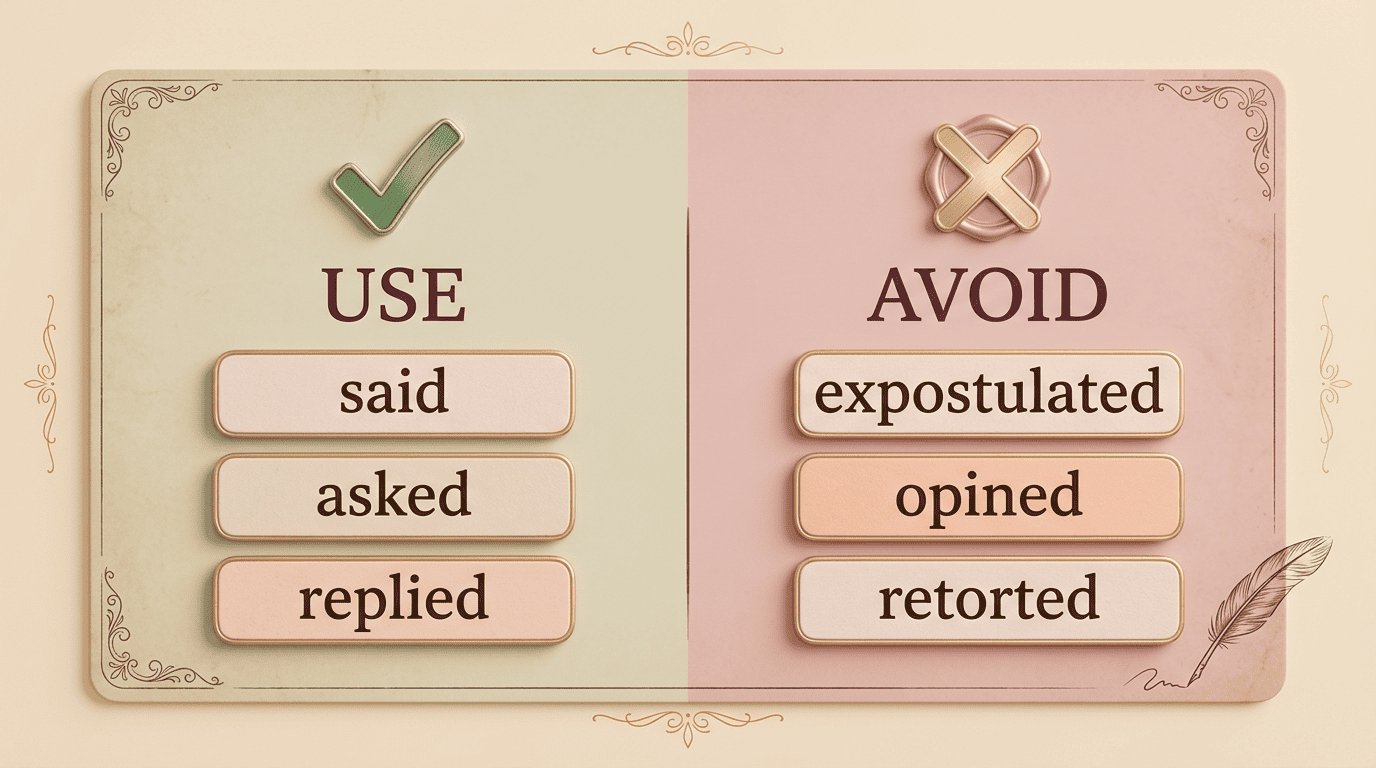
Nothing marks an inexperienced manuscript faster than a page of «she exclaimed,» «he retorted,» «they queried.» The fix is almost embarrassingly simple, and it’s one of the most repeated pieces of advice in craft writing for a reason.
«Said» disappears; fancy tags shout
Readers’ eyes skate over «said» and «asked» — that’s the point. Elmore Leonard’s rule on the subject is blunt:
Never use a verb other than «said» to carry dialogue.
Elmore Leonard, «Writers on Writing,» The New York Times (2001)
Thesaurus tags — «expostulated,» «opined» — pull the reader out of the story and read as amateurish, a criticism shared by the Center for Fiction and The Novelry.
Adverbs and non-speaking verbs
Go easy on adverbs: «said loudly» is weaker than «yelled.» Keep an adverb only when the delivery surprises the reader — «‘I hate you,’ she said quietly.» And you can’t «smile» or «stomp» a line; those are action beats, not tags, and belong in their own sentence, a distinction both Writers.com and MasterClass draw explicitly.
Ground Scenes with Action Beats
Action beats do double duty: they attribute speech and they keep the reader inside the room. A scene made entirely of quoted lines with no bodies in it starts to feel like a radio play instead of a story with weight and space.
Below is a short step-by-step pass for converting a flat exchange into one grounded in action:
- Read the exchange and mark every «said» tag.
- Ask which tags are load-bearing (needed to track who’s speaking) versus decorative.
- Replace one decorative tag per exchange with a physical action — a gesture, a glance, a small task the character is doing.
- Check that the action beat tells the reader something about mood or intent, not just movement for its own sake.
- Read the passage aloud; if attribution is still unclear, add one more beat rather than another tag.
- Cut any beat that repeats information the line of dialogue already gives.
- Confirm the paragraph still breaks on every change of speaker.
Let bodies talk
An action beat — a gesture, a movement, a glance — attributes a line without a tag and roots the scene in the physical world. «She set down her cup. ‘We need to talk.'» tells us who spoke, and how, without a single «said,» a technique highlighted by The Novelry, Jericho Writers, and Grammarly alike. Use beats to control pace: more beats slow a scene down; bare exchanges speed it up.
Punctuate and Format Dialogue Correctly
Formatting mistakes are the fastest way to knock a reader — or an agent — out of a manuscript, even when the dialogue itself is strong. The rules are mechanical, which makes them easy to get exactly right once you’ve seen them laid out.
The core punctuation rules
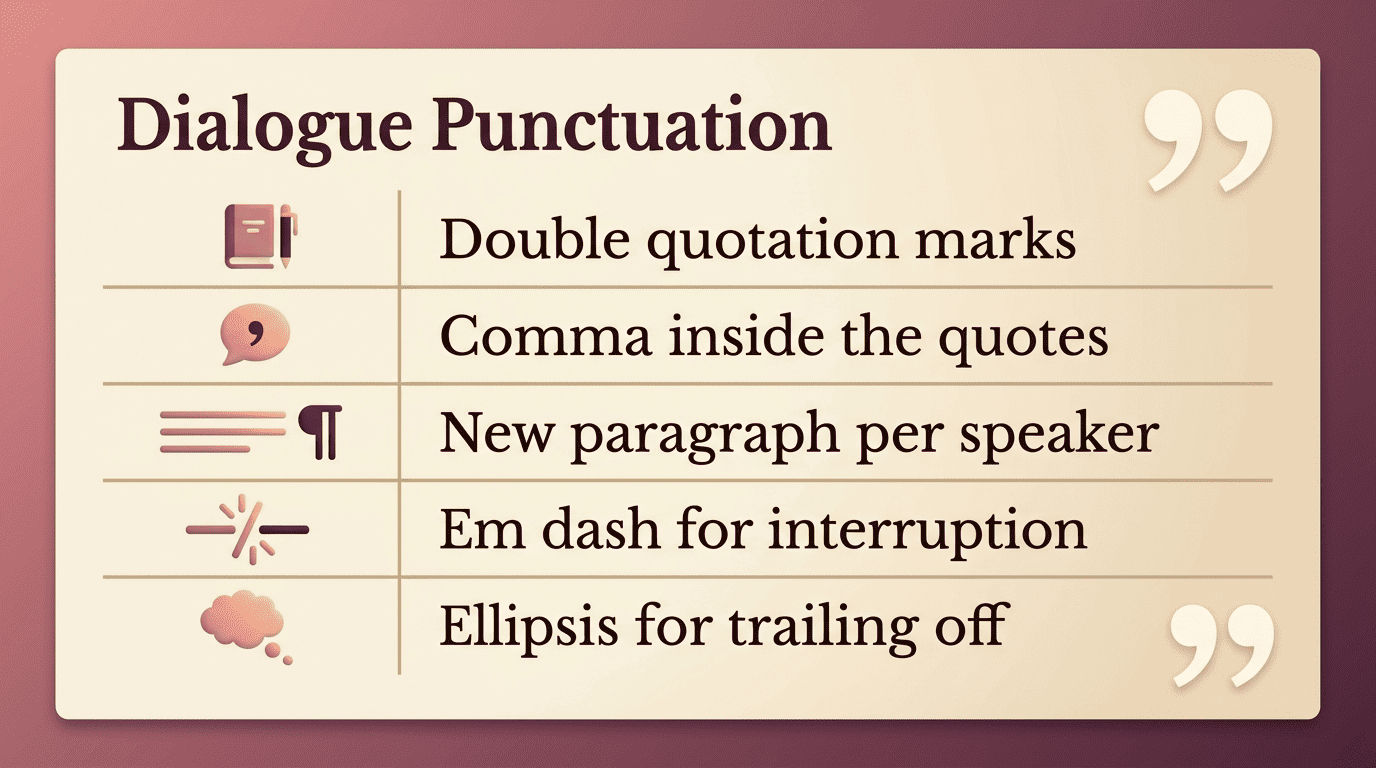
Enclose speech in double quotation marks; in US style, commas and periods go inside the quotes. A tag joins with a comma: «Hi,» she said. Start a new, indented paragraph every time the speaker changes — even for a one-word reply. For the full reference on quotation-mark mechanics, see the Purdue OWL guide to quotation marks.
Interruptions, trailing off, and long speeches
Use an em dash (—) when one character cuts another off, and an ellipsis (…) when a line trails away. When a single speaker runs across several paragraphs, put opening quotes at the start of each paragraph but the closing quote only at the very end, a formatting rule both MasterClass and Grammarly cover in detail.
| Situation | Punctuation | Example |
|---|---|---|
| Interruption | Em dash inside the quotes | «I was just about to—» |
| Trailing off | Ellipsis inside the quotes | «I don’t know if I…» |
| Tag after a statement | Comma before closing quote | «Hi,» she said. |
| Speaker changes | New paragraph, every time | — |
| Speech spans paragraphs | Open quotes each paragraph, close only at the end | — |
Common Dialogue Mistakes to Avoid
Most weak dialogue fails for one of two reasons: it’s explaining something to the reader instead of the characters, or it’s padded with the verbal filler real speech is full of but fiction can’t afford.
«As you know, Bob» and other info dumps
Characters shouldn’t explain things to each other that they both already know just to inform the reader — it reads false the instant it happens, a failure mode both the Center for Fiction and Writer’s Digest single out by name. Feed backstory in small, motivated pieces instead, dropped where a character actually has a reason to say them.
Filler and dead lines
Cut the «um,» «uh,» «I mean,» and the phone «Hello? … Hi … How are you?» throat-clearing unless it carries weight. Real speech is padded; good dialogue is the edited highlight reel of a conversation, not a court transcript of one. Lines that are usually safe to cut on a first pass:
- Greetings and goodbyes that don’t set up a beat
- Verbal tics («um,» «uh,» «like,» «I mean»)
- Restating something the reader already knows
- Small talk that isn’t hiding tension underneath it
Writing Romantic Dialogue: Banter, Tension, and Slow Burn
Romance runs almost entirely on dialogue, which makes it the genre where these rules matter most. Two characters in a scene together, talking, is often the whole engine of a chapter — so the craft has to hold up under weight.
Chemistry lives in the subtext
Romantic tension is subtext at its purest: two people talking about the weather while meaning something else entirely. Fast, overlapping banter signals sparks in an enemies-to-lovers dynamic; long pauses and things left unsaid build a slow burn instead. If you’re drafting a love scene, a romance writing ai can help you test whether the tension actually reads on the page — and keep intimate moments tasteful with a «fade to black» rather than explicit description.

Give each half of the couple a different beat
The best romantic exchanges aren’t two people agreeing — they’re two distinct voices colliding, teasing, and misreading each other. One character undercuts tension with a joke; the other goes quiet exactly when it matters. Distinct voice plus subtext is the whole engine of a good love scene, and neither works without the other.
Edit by Ear: The Read-Aloud Test
The single most reliable dialogue edit costs nothing and takes minutes: read the scene out loud, in the voice of the character speaking, and listen for the moment it stops sounding like a person.
Trust your ear
Read every exchange out loud. If it sounds like a lecture, it’s overwritten; if you stumble over a line, so will the reader, a diagnostic both the Center for Fiction and Writer’s Digest recommend as a final pass. Trust your ear over any rule in this guide when the two conflict. Listen specifically for:
- Sentences too long or formal to say in one breath
- Missing contractions that make a casual character sound stiff
- Two characters who suddenly sound interchangeable
- A line that explains instead of expresses
Reading aloud — or having an ai romance writing assistant read a scene back to you — is the fastest way to catch stilted, unnatural lines before a reader ever sees them.