
How to Write a Romance Novel: A Step-by-Step Guide From Idea to Happy Ending
Writing a romance novel means guiding two characters from the spark of a meet-cute through real emotional conflict to an earned Happily Ever After. According to the Romance Writers of America, a romance is defined by exactly two elements — a central love story and an emotionally satisfying ending — so whether you outline every beat or draft by instinct, or lean on an ai romance writing assistant to brainstorm and polish, the craft comes down to a handful of repeatable moves.
This guide walks through the whole arc — choosing your subgenre and trope, building characters readers ache for, structuring the three acts, sustaining tension, and landing the ending the genre promises. Romance is the biggest-selling fiction genre, and it rewards writers who honor its emotional contract.
Know the Rules of the Genre Before You Write
Every genre has conventions, but romance is unusually strict about just two of them. Get these right and almost everything else — setting, tone, heat level, subgenre — is yours to invent.
The two non-negotiable promises
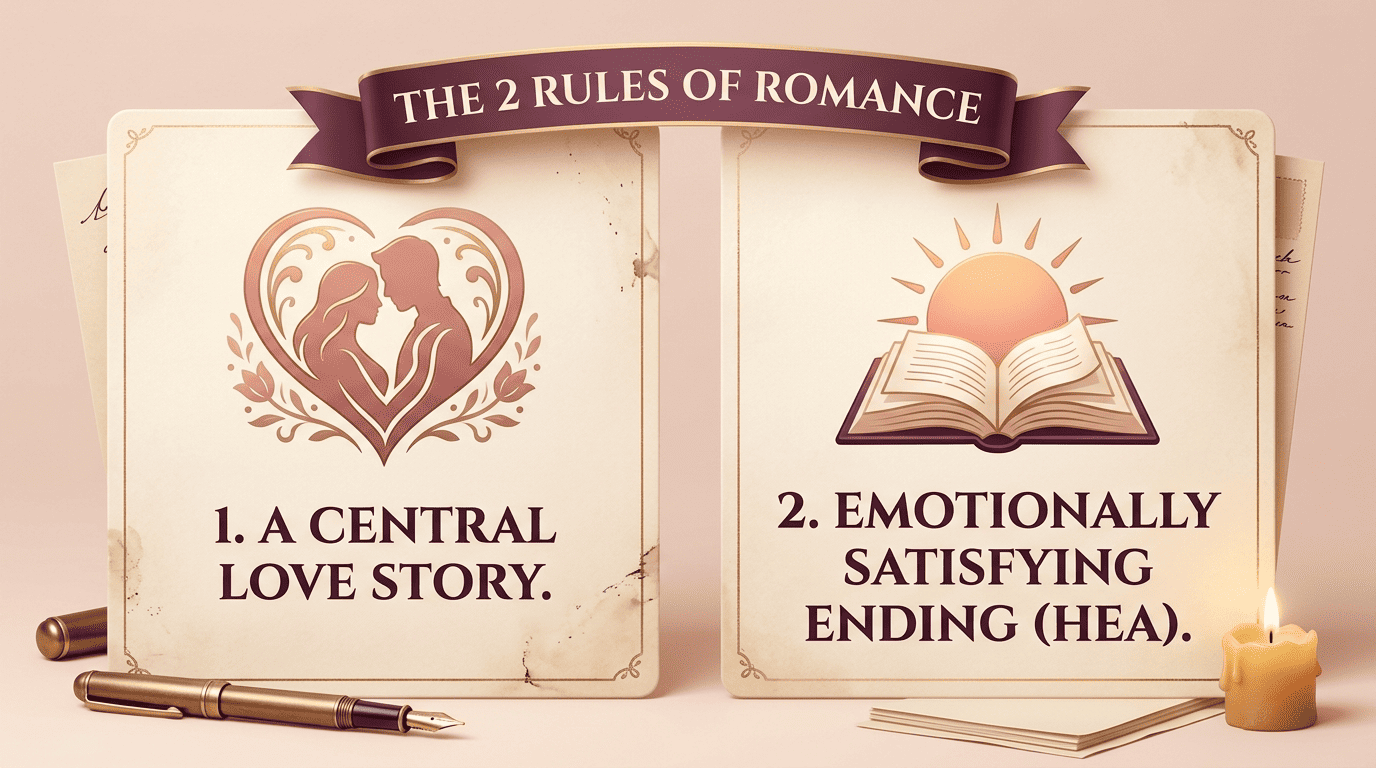
Romance has exactly two rules per the Romance Writers of America’s definition of the genre: a central love story and an emotionally satisfying, optimistic ending — HEA (Happily Ever After) or HFN (Happy For Now). Break either one and readers feel cheated, no matter how strong the prose is elsewhere. The love story has to be the plot’s spine, not a subplot riding alongside a mystery or a thriller.
A romance or romantic novel is a genre fiction work focused on the relationship and romantic love between two people, often concluding with an emotionally satisfying or optimistic ending.
Wikipedia, Romance novel
Why the «contract» with readers matters
Romance is the best-selling fiction genre in the United States, and its readers know the beats and buy specifically for the emotional payoff. Meeting that contract is freedom, not limitation — it lets you surprise readers with how the couple ends up together, not whether they will. The tension of the story lives in the journey, never in doubt about the destination.
Start With a Strong Idea: Subgenre, Trope, and Premise
Before you outline a single scene, narrow your idea down to something you could pitch in one breath. Two ingredients do most of the work: subgenre and trope.
Pick a subgenre that fits your voice. Contemporary, historical, romantasy, paranormal, YA, romcom, and literary romance all promise different reading experiences, so choose the one that matches the tone you actually want to write. A cozy small-town romcom and a dark romantasy share the two genre rules above but almost nothing else in pacing or voice.
Layer in a trope, not a cliché. Enemies-to-lovers, grumpy/sunshine, friends-to-lovers, forced proximity, and second-chance romance are structural promises readers actively search for — they are not shortcuts around originality. One popular idea exercise is simple: subgenre + category + trope equals your premise seed.
Distill it to one sentence. Write your premise as a single logline — often called the «hook.» If you cannot say who falls for whom and what keeps them apart in one sentence, the idea is not ready to outline yet.
Five tropes cover most of the genre’s bestsellers and are worth knowing by name before you start outlining:
- Enemies-to-lovers
- Grumpy/sunshine
- Friends-to-lovers
- Forced proximity
- Second-chance romance
| Subgenre | Typical tone | Common trope pairing |
|---|---|---|
| Contemporary | Grounded, present-day | Friends-to-lovers, forced proximity |
| Historical | Period detail, formal stakes | Second-chance, enemies-to-lovers |
| Romantasy | Fantasy world-building + romance | Fated mates, enemies-to-lovers |
| Romcom | Light, banter-driven | Grumpy/sunshine, mistaken identity |
Build Characters Readers Fall For
A trope gets readers to open the book. Characters keep them reading past chapter three.
Give each lead a goal, a flaw, and a wound
Both leads need aspirations, flaws, and quirks — and crucially, a goal outside the love story, so they read as people first and love interests second. The wound — a false belief or a fear formed before page one — is the internal barrier that love will eventually heal. Without it, the couple’s obstacles feel arbitrary rather than earned.
Let love change them
The romance arc is the character arc: to be loved is to be changed. Editors consistently stress that conflict should come from internal emotional barriers, not external plot devices or simple miscommunication that a five-minute conversation would resolve. An ai fiction writing tool can help you pressure-test each character’s motivation and keep their arc consistent scene to scene, catching the moment a character acts against their established wound.
Structure the Three Acts (and the Beats)
Once you know your leads, map where their relationship turns. Romance has one of the most reliable structural skeletons in commercial fiction.
The classic word-count map
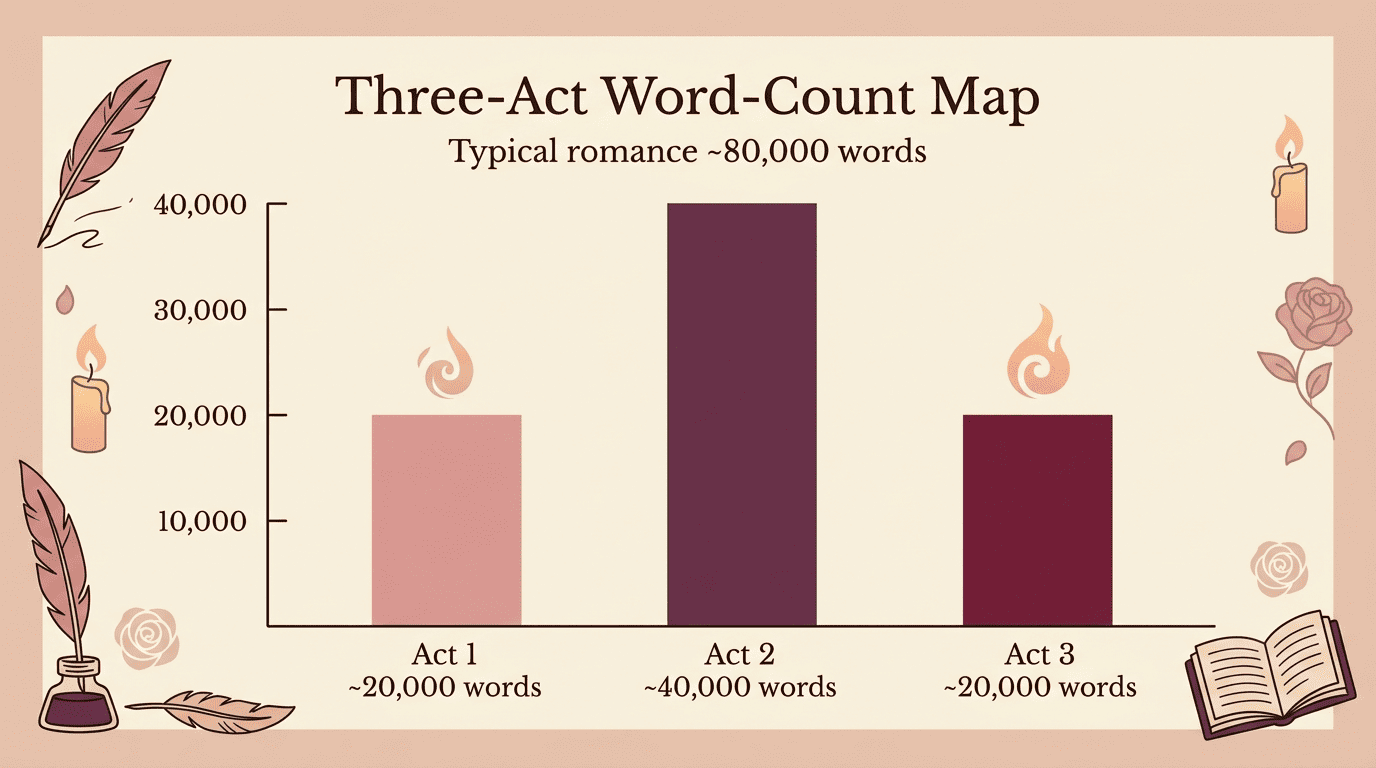
A typical single-title romance runs around 80,000 words, though category romance can be shorter and romantasy often runs longer. Mapped onto the three-act structure — a model with roots in classical dramatic theory, as Wikipedia’s entry on three-act structure lays out — Act 1 covers roughly 25% (about 20,000 words), Act 2 covers 50% (about 40,000 words), and Act 3 covers the final 25% (about 20,000 words).
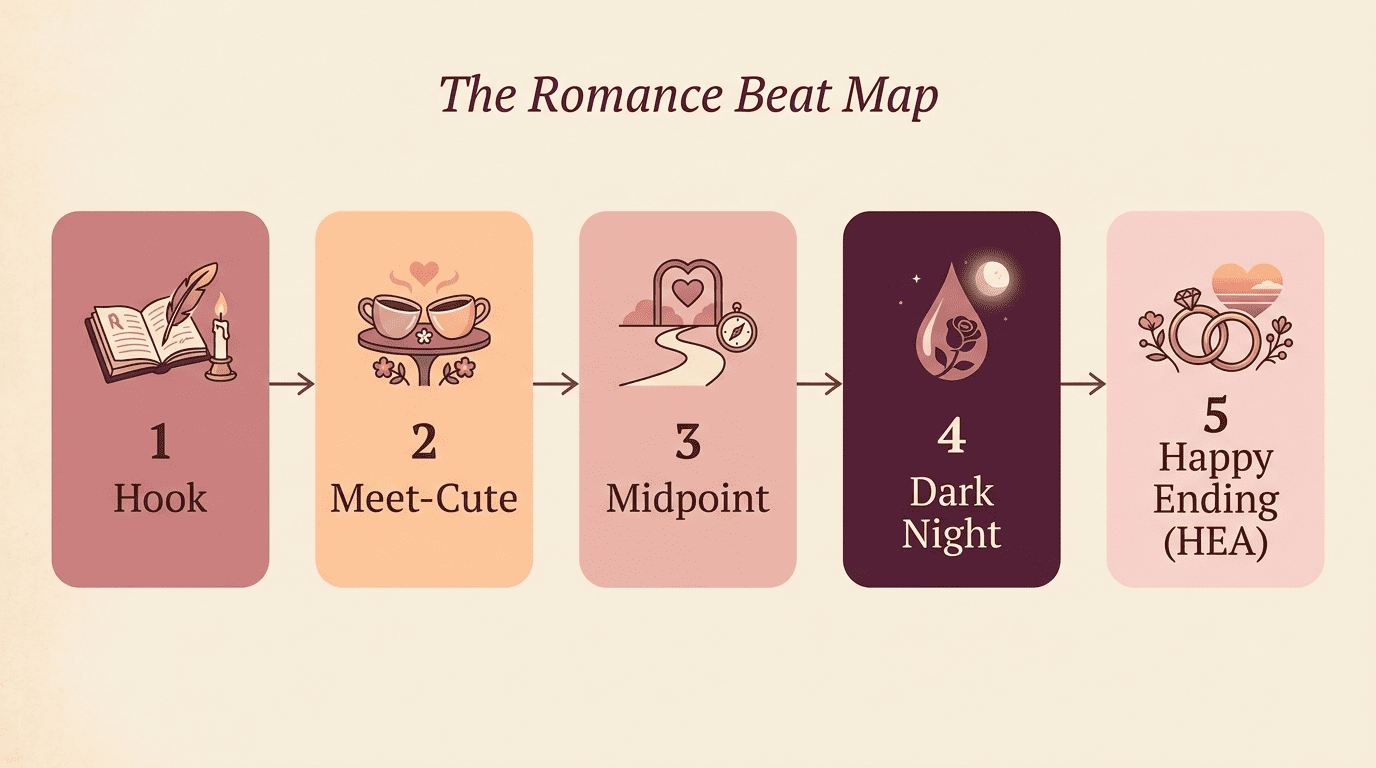
A common beat map places the inciting incident — the leads meeting — around the 12% mark, the midpoint at 50%, the crisis near 88%, and the climax around 90%.
- Hook (1%) — open the story in motion, not backstory.
- Inciting incident / meet-cute (12%) — the leads share the page for the first time.
- Rising tension (12–50%) — attraction builds against the internal barrier.
- Midpoint (50%) — the relationship’s dynamic shifts, often toward false victory.
- Crisis (88%) — the Dark Night of the Soul; the couple seems doomed.
- Climax (90%) — a lead actively chooses the relationship.
- Resolution (98%) — the HEA or HFN pays off the genre promise.
The nine key romance moments
One widely used spine breaks a romance arc into nine emotional beats, and hitting them in roughly this order keeps the pacing recognizable to romance readers whether you plot every beat in advance or write by instinct:
- Meet-cute
- Initial interest
- Withdrawal
- Increased intimacy
- Change in dynamic
- Maximum intimacy
- Falling out
- Big gesture
- Coming together
Write the Meet-Cute and Open in the Middle of the Action
The first pages decide whether a reader keeps going, and in romance that first impression is almost always the meet-cute.
Make the meeting the inciting incident
The moment your leads first share the page is your inciting incident. Merriam-Webster defines a meet-cute as «a cute, charming, or amusing first encounter between romantic partners.» It should crackle with the promise of everything to come — tension, humor, or friction that hints at the chemistry ahead.
Start with a bang
With roughly 2.2 million new books published every year, an opening has to earn the read fast. A reliable formula: open in the middle of action, add a touch of humor, ground the reader in a specific location, and reveal character — both perspective and the romantic problem the lead is carrying. Skip the backstory dump; readers can learn a character’s history in scene, later, when it matters.
Sustain Romantic Tension and Chemistry
Structure gets a couple onto the page together. Tension is what keeps readers turning pages between the meet-cute and the ending.
Keep them apart (believably)
Chemistry lives in the gap between two people who want each other and can’t yet have each other. The «will they, won’t they» engine only works if the barrier is real and internal — a genuine fear or wound, not a contrived misunderstanding. Slow-burn tension builds through near-misses, longing, and rising stakes, not manufactured obstacles that a single honest conversation would dissolve.
Use the Dark Night of the Soul
Around the crisis beat, engineer the moment the couple seems truly doomed — the Dark Night of the Soul. This low point, arriving near the 88% mark of the manuscript, is what makes the eventual reunion feel earned rather than inevitable. Skip it, and the climax can feel too easy.
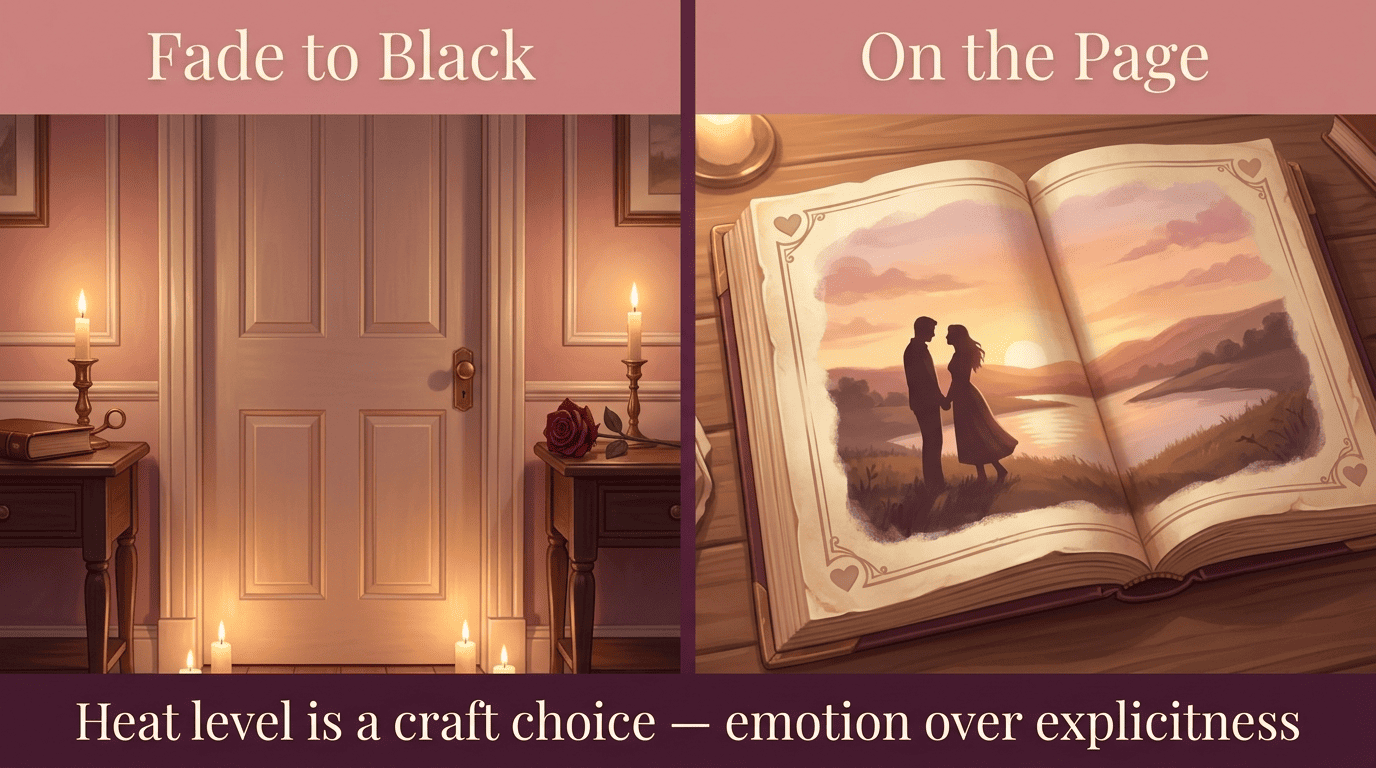
Handle Intimacy With Craft: Fade-to-Black to On-Page
Heat level is one of the most personal craft decisions a romance writer makes, and there is no single right answer.
Choose your heat level deliberately
Intimacy in romance runs a spectrum, and «heat level» is a craft choice, not a requirement. Many bestsellers use fade-to-black — cutting away at the threshold of a scene — while others lean on suggestion and emotional closeness to carry the moment instead of explicit detail. What matters for the reader is emotional truth, not explicitness: the scene should reveal what the characters risk and what it means for them, whether the door is left open or closed.
Make the emotion do the work
Whether a scene closes the door or stays on the page, the tension should come from what the moment means to the characters — vulnerability, trust, transformation. A tasteful romance writing ai can help you draft a fade-to-black beat that lands the feeling without the graphic detail, keeping the focus on what the characters are risking emotionally rather than on choreography.
A few markers tend to separate scenes that work from ones that feel gratuitous:
- The scene follows a moment of real emotional risk, not just physical proximity.
- What changes for the characters afterward is clear — trust, vulnerability, or a barrier coming down.
- The heat level stays consistent with the rest of the book’s tone.
- The scene could be summarized by what it reveals about the relationship, not just what happens in it.
Land the Happy Ending — Then Revise
Every beat up to this point exists to make the ending pay off. Don’t skip the revision pass that turns a draft into a finished manuscript.
Deliver the promised ending
The climax is the grand gesture — a lead actively chooses the relationship, overcoming the internal barrier established back in act one. Then the resolution delivers the HEA or HFN. This payoff is the entire reason readers picked up a romance novel instead of another genre.
Revise, then get fresh eyes
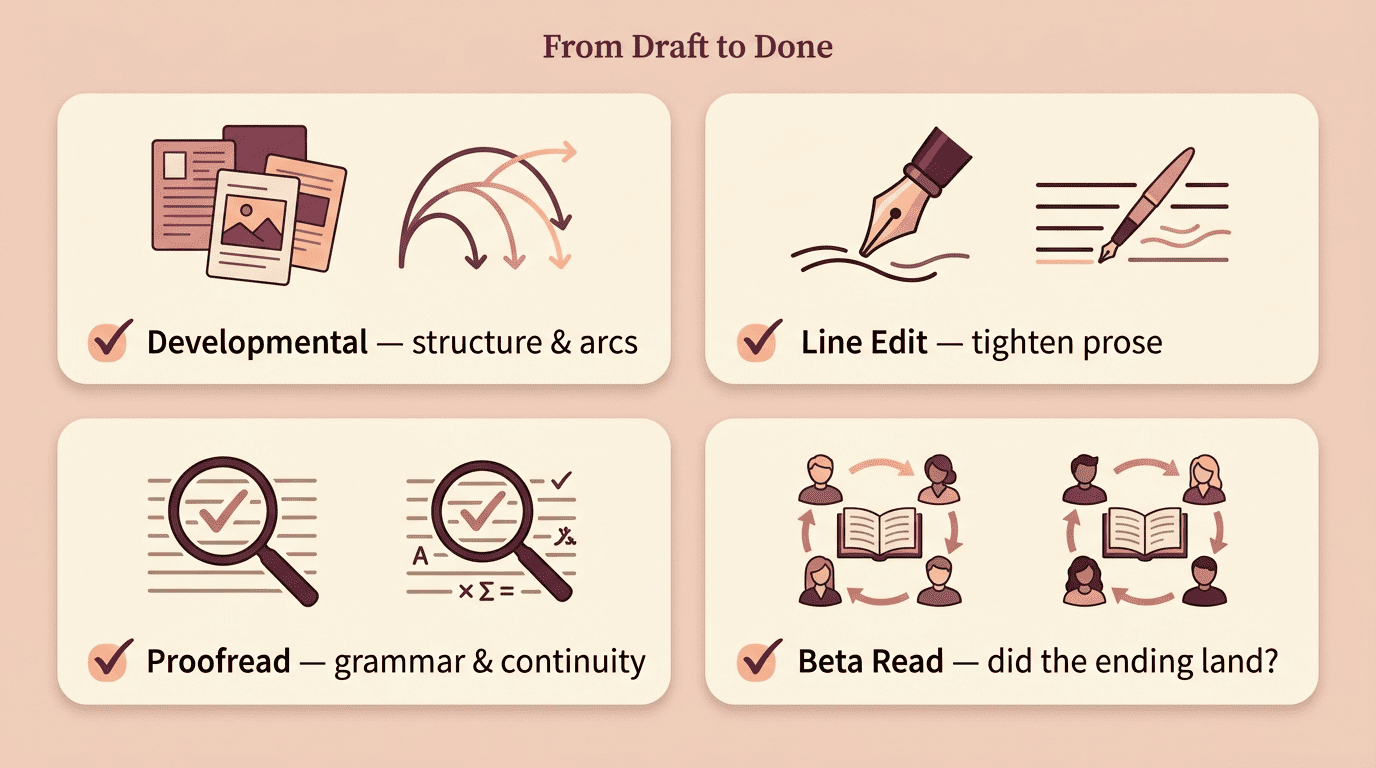
Here is a simple path from finished draft to submission-ready manuscript:
- Finish the «shitty first draft» — get the whole story down without editing as you go.
- Let the manuscript rest for at least a week before rereading.
- Do a developmental pass — fix structure, pacing, and character arcs first.
- Do a line edit — tighten prose sentence by sentence.
- Proofread for grammar, spelling, and continuity errors.
- Send it to beta readers for the emotional read: did the ending land?
- Revise once more based on beta feedback before querying or publishing.
| Edit pass | Focus | Question it answers |
|---|---|---|
| Developmental | Structure, pacing, arcs | Does the story work as a whole? |
| Line edit | Prose, rhythm, word choice | Does every sentence pull its weight? |
| Proofread | Grammar, spelling, continuity | Are there errors left to catch? |
| Beta read | Emotional impact | Did the ending land the way it should? |
Revision is where a romance becomes swoon-worthy — most of what separates a solid manuscript from a forgettable one happens after «The End,» not before it.