
How to Overcome Writer’s Block: A Fiction & Romance Writer’s Field Guide
The blinking cursor, the half-finished love scene, the chapter that won’t move — every novelist meets writer’s block eventually, and it’s rarely about talent. Below are the real causes and the fastest fixes, plus where an ai romance writing assistant can hand you the next sentence when you’re truly stuck.

What Writer’s Block Really Is (and Isn’t)
The stuck feeling has a name, a history, and a much shorter shelf life than it feels like at 11 p.m. staring at a blank document.
It has a name and a history
Psychoanalyst Edmund Bergler coined the term «writer’s block» in 1947, but the experience predates the label by well over a century. Samuel Taylor Coleridge described the first recorded instance in 1804, calling it an «indefinite indescribable Terror» — proof that even the poets behind the classics you studied in school stared down the same blank page. You’re in good company, and the block itself isn’t evidence that something is wrong with your talent.
It’s usually a symptom, not the disease
Fantasy author L.R. Lam put it plainly:
For me, writer’s block is 100% loss of confidence, second guessing my intuition.
L.R. Lam
That reframe matters more than any productivity hack. Writer’s block usually isn’t a mysterious ailment — it’s fear, perfectionism, or a story problem wearing a scarier costume. Name what’s actually underneath the block and it tends to lose a good chunk of its power immediately.
The Four Root Causes Behind a Block
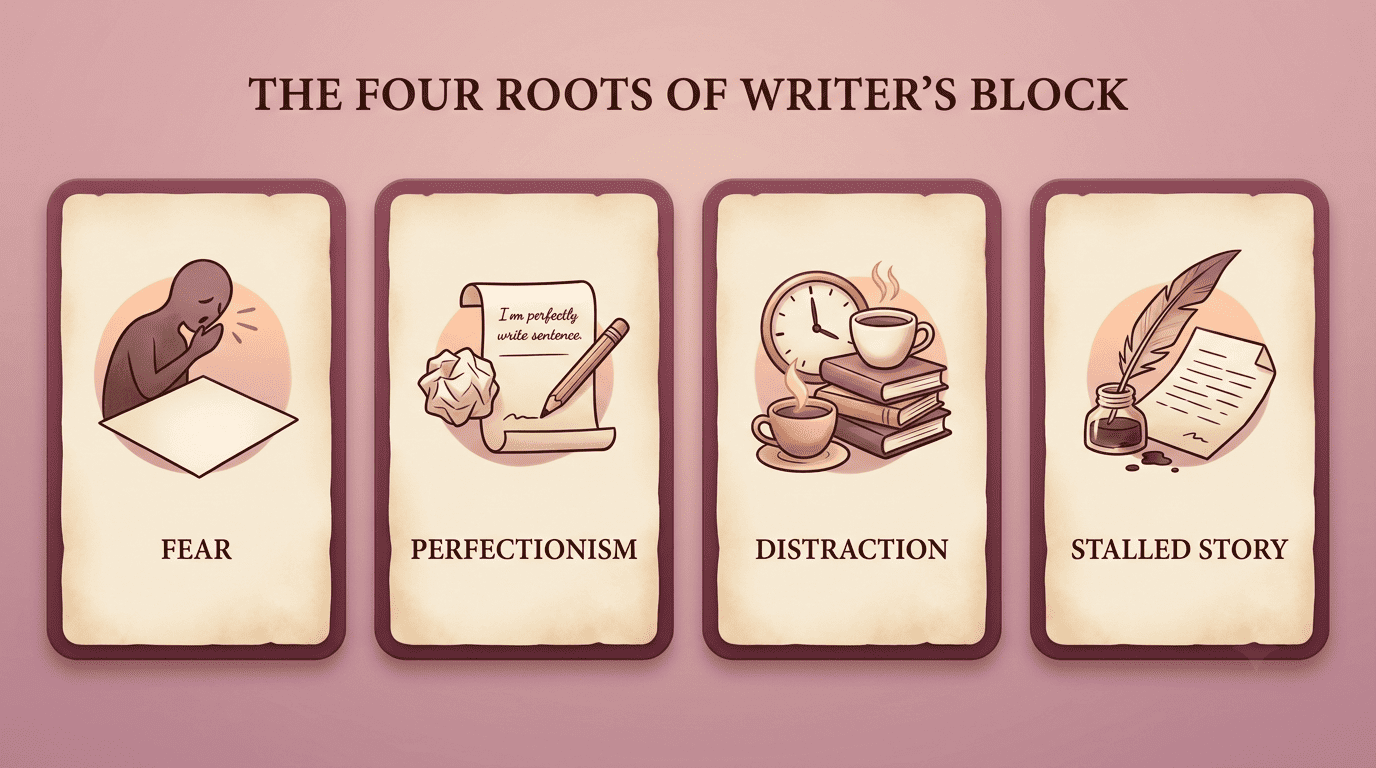
Most writing coaches land on the same short list once you strip away the mystique: fear, perfectionism, distraction, and a stalled story. Match the cause to its cure and the block usually loosens within days, not months.
| Root cause | How it shows up | The cure |
|---|---|---|
| Fear | «It’ll never be published,» avoiding the page entirely | Write for yourself first; journal why you write |
| Perfectionism | Editing every sentence before finishing it | Separate drafting from editing — write ugly now |
| Distraction | Can’t hold focus long enough to reach flow | Kill notifications; protect the first 7 minutes |
| A stalled story | The block only hits one specific scene, not all writing | Diagnose the craft problem — wrong POV, wrong entry point |
Fear (of failure, of judgment)
«It’ll never be published.» «Someone’s going to laugh at this.» That inner voice is loud, and more willpower rarely drowns it out. The fix that actually works is writing for yourself first — draft the scene as if no one but you will ever read it, and save the audience-facing worry for the editing pass. If the fear keeps circling back, spend five minutes journaling why you write in the first place; it’s usually not for the judgment you’re bracing for.
Perfectionism
Perfectionism is the surest route to paralysis, because it asks you to write and judge a sentence in the same breath. The cure is separating drafting from editing entirely: write ugly now, polish later. That’s not a shortcut — it’s the actual craft advice behind most published novels, and it’s echoed by working novelists like Jerry Jenkins and by university writing centers like Purdue’s.
Distraction and lost flow
Getting into flow state — the deep, absorbed concentration psychologist Mihaly Csikszentmihalyi described — takes longer than most writers give it credit for. Novelist Alice Kuipers has pointed out that you often have to push through roughly the first seven minutes of resistance before flow arrives, and most people quit right before that point. Kill notifications, use a blocking app, or write offline or by hand for that first stretch so nothing pulls you out before flow has a chance to kick in.
A story problem wearing a block costume
Sometimes what feels like a block is the manuscript itself telling you a scene is wrong — the wrong POV, the wrong entry point, a plot turn your characters wouldn’t actually make. That’s a craft fix, not a discipline fix, and it’s worth diagnosing before you blame yourself for a problem that actually lives on the page.
Fast Techniques to Start Writing Today
These aren’t long-term routines — they’re the techniques you reach for in the next ten minutes, when the page is blank and staying blank is starting to feel permanent.
Freewrite the block away
Set a timer for 10 minutes and write without stopping, without editing, and without judging what comes out — even if it’s «blah blah blah» for the first thirty seconds. This is the same engine behind Morning Pages, Julia Cameron’s daily longhand practice: the goal is quantity, not quality, and quantity is what breaks the freeze.
Skip the stuck scene — write out of order
«Begin in the middle,» as Purdue’s Online Writing Lab puts it. Jump straight to the scene that excites you — the confession, the confrontation, the kiss you’ve been dying to write — and come back for the connective tissue later. The reader never sees the order you wrote in.
Shrink the goal until it’s impossible to fail
A daily target of 100 words, one page, or a single line of dialogue sounds too small to matter, but momentum compounds. Hitting a tiny goal five days in a row rebuilds the habit far faster than one heroic, unsustainable binge.
Change your body, change your brain
A short walk, a change of room, or a few minutes of stretching restores focus in a way that staring harder at the screen never does. Counterintuitively, some writers swear by «practicing boredom» — deliberately sitting with nothing to do — as fuel, since the brain often solves a stuck scene the moment it’s allowed to wander.
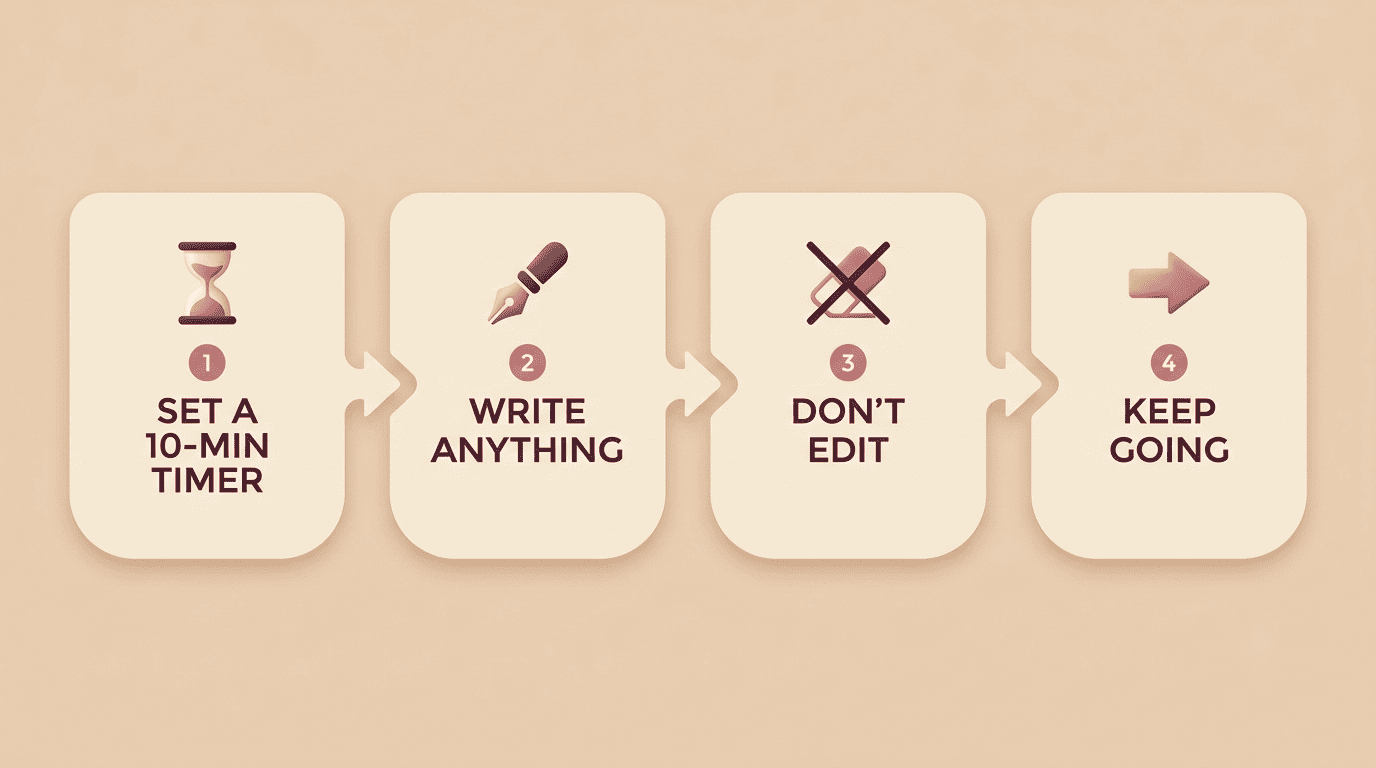
When a scene truly won’t come no matter what you try, an ai fiction writing tool can generate ten alternative openings or a quick brainstorm of «what happens next» for you to react against. Four fast techniques worth keeping on hand for exactly that moment:
- Freewrite for 10 minutes, no stopping, no editing
- Write out of order — start with the scene that excites you
- Shrink the daily goal to 100 words or one page
- Take a walk or switch rooms before opening the document again
You’re not outsourcing the writing — you’re giving your brain something concrete to argue with, and you keep only the lines that actually sound like you.
Fixes Made for Fiction and Romance Writers
Romance and character-driven fiction come with their own flavor of block, and the standard advice doesn’t always map cleanly onto a stalled love story.
Let your characters pull you forward
When plot stalls, interview your characters instead of the outline. Write a scene from the antagonist’s or the love interest’s point of view — chemistry and conflict have a way of unlocking the next chapter once you see it through someone else’s eyes. Every minor character is the protagonist of their own story, and remembering that often hands you the exact detail your main plot was missing.
Match the romance block to its cure. Not every stuck feeling responds to the same fix:
- Imposter block — narrow your focus back to the story itself and away from comparison
- Anxiety block — shrink the goal to 100 words, write out of order, and reset the counter fresh each day
- Deadline block — break the remaining work into small daily chunks of 300 to 750 words instead of one looming total
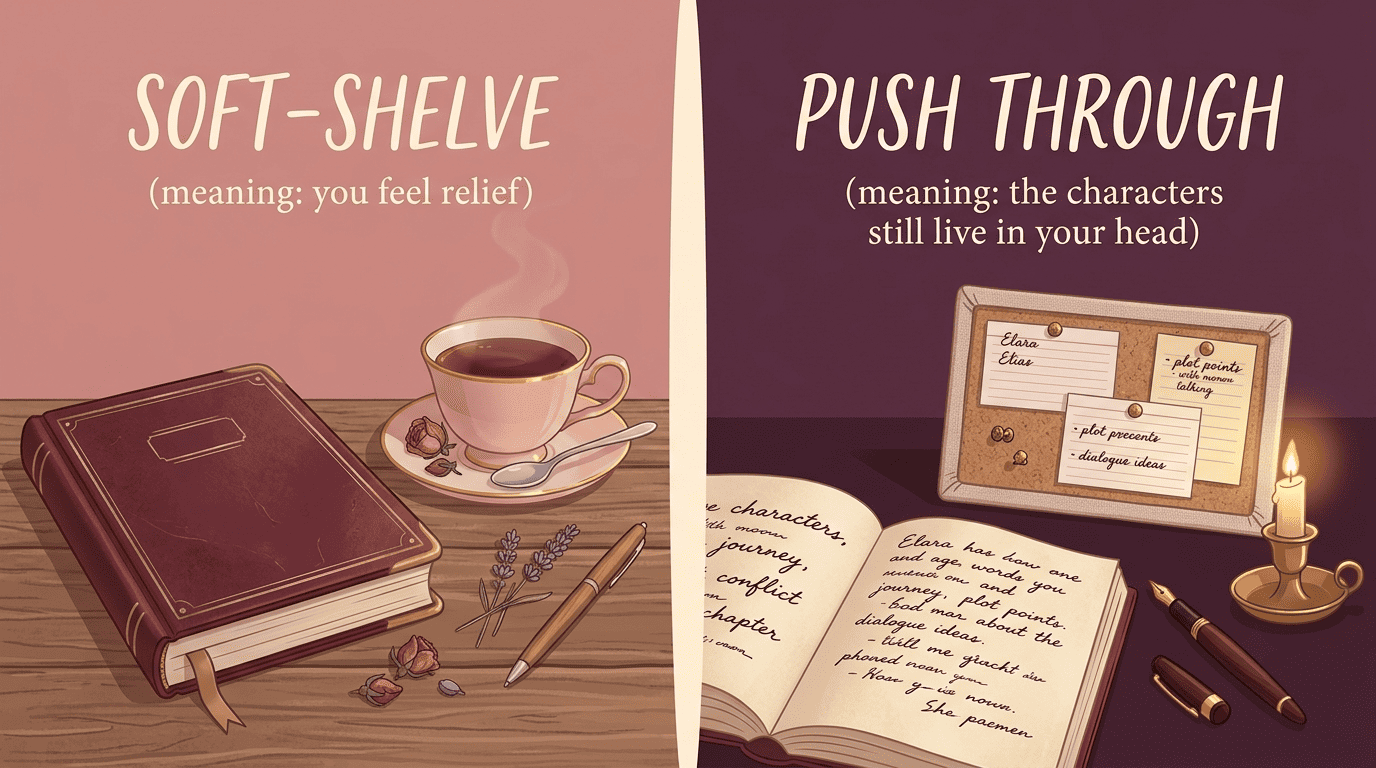
Shelve vs. push through
| Signal | What it means | What to do |
|---|---|---|
| The characters still live in your head after a few days off | The story still has pull | Go back and revise, or push through |
| Stepping away brings real relief, not guilt | The project (or this draft of it) has run its course | Let it go, or set it aside and start fresh |
| You miss specific scenes, not just «writing» in general | The block was fear or fatigue, not the story | Push through with a small daily goal |
| You feel nothing when you picture finishing it | The block may be a sign, not an obstacle | Soft shelve it and revisit in a few weeks |
A «soft shelve» — deliberately setting a manuscript aside for a few days rather than forcing it — is a legitimate diagnostic tool, not a failure. Which column you land in tells you more about the real problem than another hour of forcing sentences would.
Build a Routine That Prevents the Block
The techniques above put out fires; a routine keeps new ones from starting.
A small daily quota beats a heroic binge
Consistency, even a minimal one — 200 words, one page — rebuilds the writing muscle in a way that occasional marathon sessions never do. Penguin Random House’s author advice sums up the mindset well: «Don’t beat yourself up. Be kind. Give yourself a break.» A missed day isn’t a broken streak worth punishing yourself over; it’s a Tuesday.
Protect your flow and your energy
Same time, same place, notifications off — the boring, repeatable setup that makes flow state easier to reach each time you sit down. Walks, sleep, and time away from the screen are part of the craft too, not a break from it; a rested brain reaches that seven-minute threshold into flow faster than an exhausted one ever will.
Here’s a short routine to build the habit before the next block sets in:
- Pick one fixed time of day, even fifteen minutes, and protect it like an appointment.
- Set a daily word or time goal small enough to hit on your worst day.
- Turn off notifications and close every tab except the manuscript.
- Freewrite for the first two minutes if the page feels blank.
- Write the scene, not the transition — skip ahead if you’re stuck.
- Stop at your goal, even if you’re on a roll; leaving momentum for tomorrow beats burning out today.
- Log the day, whether it was 50 words or 2,000 — the log is what proves the routine is working.
Where an AI Writing Companion Helps You Get Unstuck
Used well, an AI tool is a spark for a stalled scene — not a substitute for your voice, your characters, or your story.
Use it as a spark, not a ghostwriter
A romance writing ai is most useful as a reaction partner. A few concrete ways it earns its place in a stalled draft:
- Generate 20 «what happens next» options and see which one makes your stomach drop in the right way
- Draft placeholder dialogue you rewrite in your own voice
- Sketch a character-relationship map when a subplot gets tangled
- Brainstorm slow-burn beat ideas, or rephrase a clunky paragraph so you can keep moving
None of that writes the book for you — it just removes the friction of the empty page so you can get back to the parts only you can write.

Keep it tasteful and keep it yours
A well-built writing assistant handles intimacy with taste — fade-to-black and emotional tension over graphic detail — and always leaves the final voice, the final word choices, and the final call on every scene to you. The tool’s job is to hand you options to push against; your job is still to write the story.