
How to Outline a Novel: 7 Proven Methods (and How to Pick Yours)
A novel outline is simply a roadmap — the plan that tells you where your story is going before you get lost writing it. According to Reedsy’s guide to outlining, a working outline is what separates a manuscript that gets finished from one that stalls at 30,000 words. Whether you’re plotting a sweeping fantasy or a slow-burn romance, an ai romance writing assistant like Nora can turn a vague idea into a scene-by-scene blueprint in an afternoon.
But there’s no single «right» outline. Below are seven proven methods the pros actually use — from the one-sentence Snowflake to the 15-beat Save the Cat sheet — plus a step-by-step path from idea to scene list, and how romance writers adapt the whole toolkit for slow burns and happy endings.
Why Bother Outlining a Novel at All?
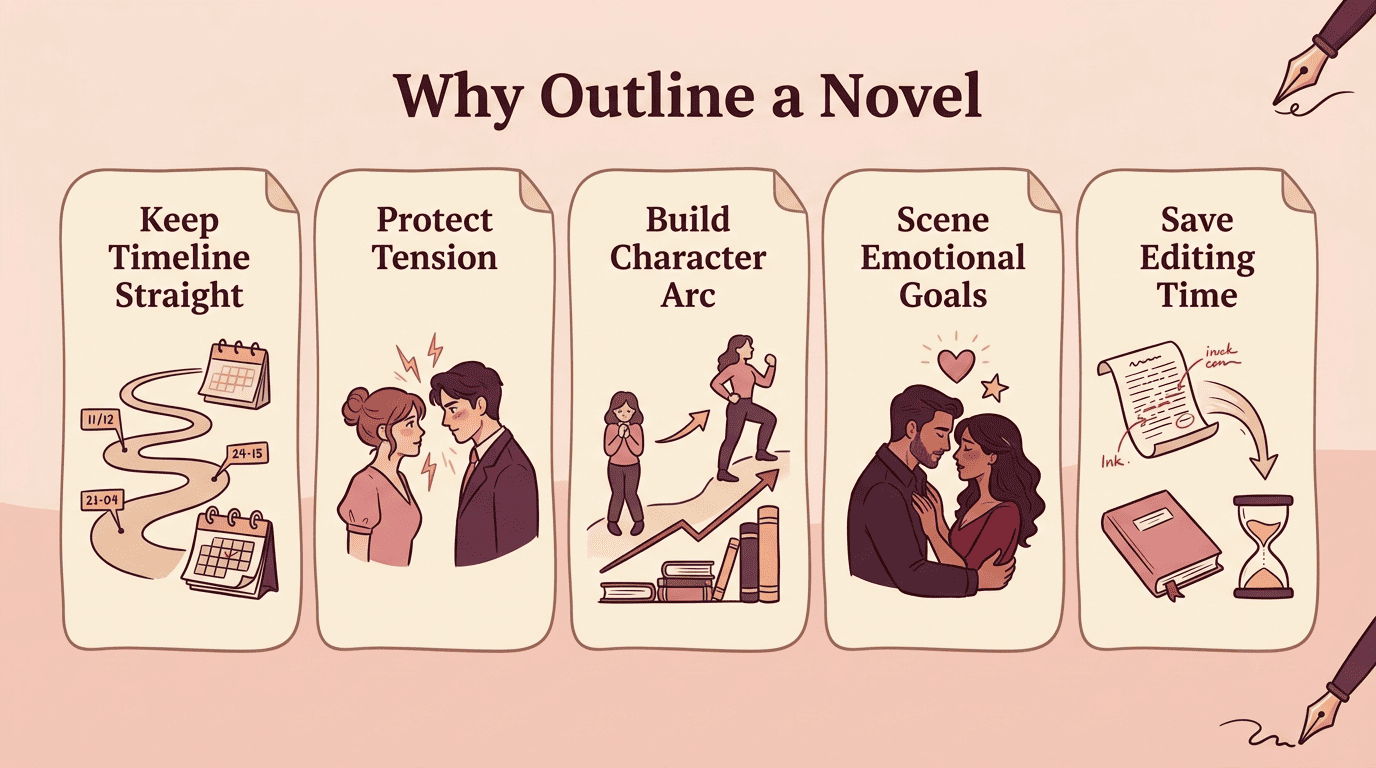
Novels are long — typically 90,000–120,000 words. A novel outline is what lets you pick the manuscript back up after a two-week gap and know exactly what happens next, instead of re-reading 40,000 words to find your place. Kristen Overman of Good Story Company gives five concrete payoffs of a story outline: it keeps your timeline straight, protects tension, builds the character arc, tracks each scene’s emotional goal, and ultimately saves time by cutting fewer dead pages later. Story Grid puts it more bluntly — a plan up front means fewer wasted words in the draft.
Plot is what happens; tension is why we keep reading. A novel outline isn’t a cage — it’s a tension map. When you can see the whole shape of the story, you can plant setups early and pay them off late, which is nearly impossible to do by accident. This matters doubly in romance, where the reader’s pleasure comes from anticipating the next collision between two people who aren’t together yet.
- Keeps the timeline and continuity straight across a 300-page manuscript
- Protects rising tension instead of letting the middle sag
- Builds a coherent character arc from the first page to the last
- Gives every scene a clear emotional goal before you write it
- Saves editing time later by cutting fewer scenes that never earned their place
Pantser vs. Plotter: Which Kind of Writer Are You?
In a Columbia University lecture later collected in Changing My Mind, novelist Zadie Smith split writers into two types, the Macro Planner and the Micro Manager. Story Grid calls the same divide the Outline Spectrum: pure pantsers — who «write by the seat of their pants» and discover the story as they go — sit on one end, meticulous plotters sit on the other, and most working authors land somewhere in the middle as «plantsers.» Even outline skeptics, like the editors at NY Book Editors who argue heavy pre-planning can leave a draft «dead on arrival,» concede that a book outline is a useful road map for a first novel.
I want to offer you a pair of ugly terms for two breeds of novelist: the Macro Planner and the Micro Manager.
Zadie Smith, «That Crafty Feeling»
The honest test is simple: does planning give you confidence to start, or does it become procrastination? Jane Friedman’s contributors put it plainly — do whatever gets you to page one, then be willing to break the plan when the story argues back.
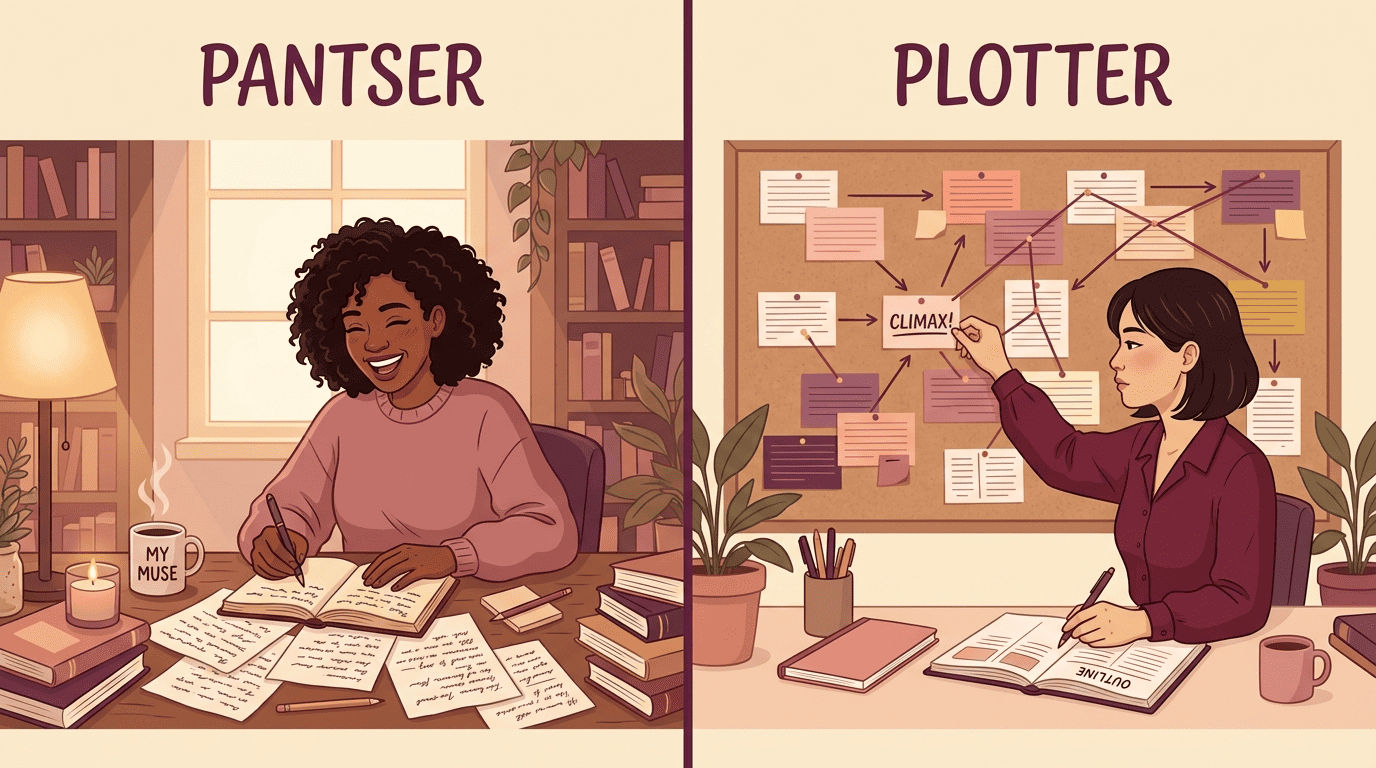
Most writers land somewhere between the two extremes, and the label matters less than the habit it points to. A committed pantser can still sketch three or four anchor scenes before drafting; a committed plotter can still leave the connective scenes loose until the story tells them what belongs there. The table below is a starting point, not a box to live in.
| Writer type | How they work | Best outline approach |
|---|---|---|
| Pantser | Discovers the story by drafting, minimal upfront planning | A one-line premise or loose beat list, revised after the draft |
| Plotter | Maps most of the story before writing a scene | Full novel outline: Snowflake, Save the Cat, or a scene list |
| Plantser | Plans the big beats, discovers the connective scenes | Foolscap-style outline — spine only, details left open |
The 7 Best Novel Outlining Methods
Three-Act Structure. The oldest and most flexible framework. Act 1 (setup) introduces your characters and world and ends with the Inciting Incident that knocks life off balance; Act 2 (confrontation) escalates obstacles to a midpoint and a low point; Act 3 (resolution) delivers the climax and aftermath. It shares roots with Freytag’s Pyramid, the older five-stage dramatic arc of exposition, rising action, climax, falling action, and denouement.
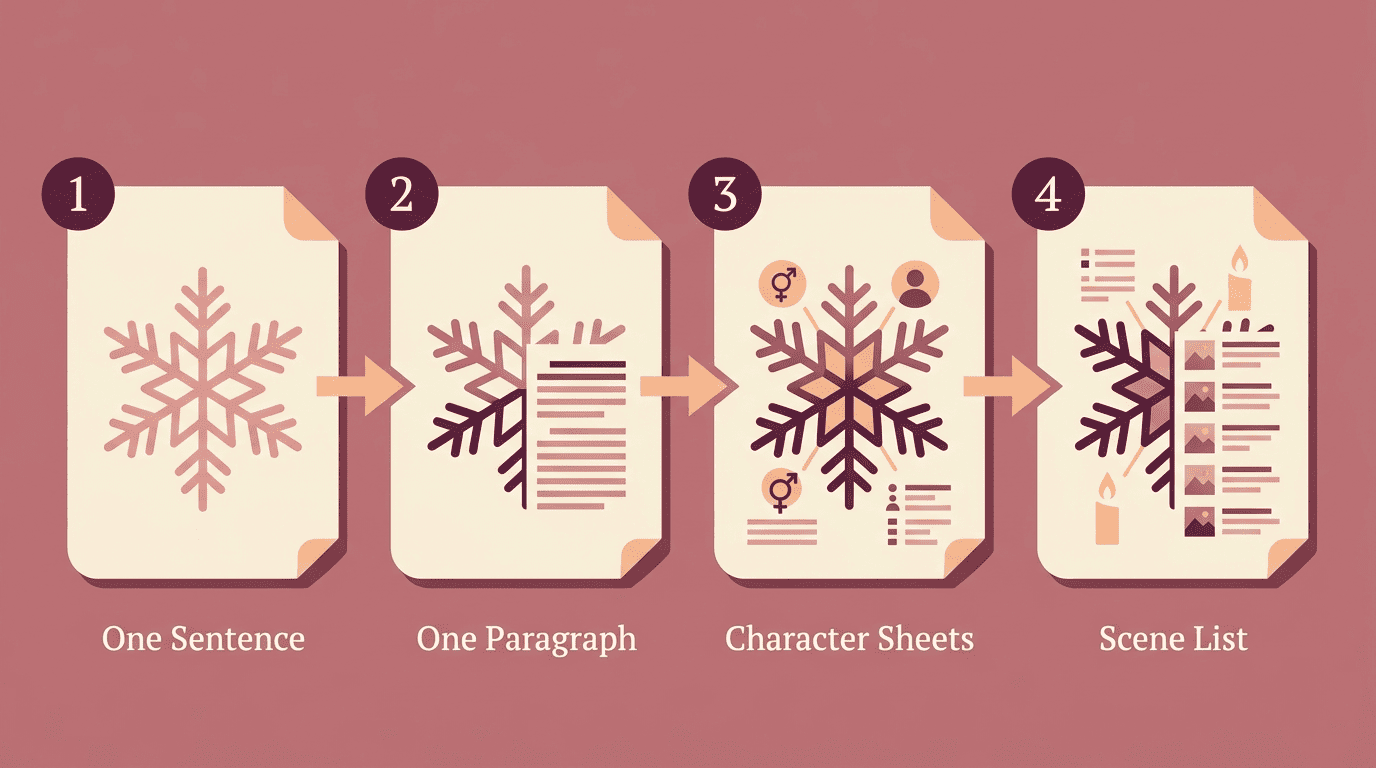
The Snowflake Method. Created by physicist-turned-novelist Randy Ingermanson, the Snowflake Method starts with a single one-sentence summary of your book, then expands it — one paragraph, then a page, then character sheets, then a scene list — each pass adding detail like a snowflake growing from a simple shape. Ideal for writers who want structure but hate committing to details too early.
Save the Cat! Beat Sheet. Screenwriter Blake Snyder’s Save the Cat! beat sheet maps a story across 15 beats — Opening Image, Catalyst, Break into Two, Midpoint, All Is Lost, Dark Night of the Soul, Finale. Author Jessica Brody adapted it for prose in Save the Cat! Writes a Novel, and it’s especially popular with genre and romance writers because the beats are precise and emotionally reliable.
The Hero’s Journey. Joseph Campbell’s monomyth — originally mapped as 17 stages in The Hero with a Thousand Faces — underlies everything from Star Wars to countless fantasy epics. Screenwriter Christopher Vogler streamlined it for working writers into the 12-stage version most novelists actually use: Ordinary World, Call to Adventure, the Ordeal, the Return. Best for transformation-heavy stories with a clear protagonist quest.
The Seven-Point Story Structure. Popularized by novelist Dan Wells, the seven points — Hook, Plot Turn 1, Pinch 1, Midpoint, Pinch 2, Plot Turn 2, Resolution — are cleverly planned backward: you decide the ending first, then reverse-engineer the turns that get you there.
Logline + Foolscap. Story Grid’s approach begins with a one-sentence, roughly 25-word logline (hero + goal + problem), expands to a 250–300-word jacket-cover blurb, then a single «Foolscap» page listing the 15 spinal scenes and the five commandments of story: Inciting Incident, Turning Point, Crisis, Climax, Resolution.
Scene and Sequel. For writers who think in scenes, the Scene-and-Sequel method — goal, conflict, disaster, then reaction, dilemma, decision — chains individual scenes into momentum. It’s a granular complement to any of the big-picture structures above, not a replacement for them.
None of these seven methods are mutually exclusive — most working novelists borrow pieces from several at once. A few common pairings:
- Snowflake for the first pass, Save the Cat to check the pacing once the shape exists
- Three-Act Structure as the spine, Scene and Sequel to draft each individual scene
- Logline + Foolscap for a fast first outline, Hero’s Journey for a transformation-heavy rewrite
- Seven-Point Structure when you already know your ending and need to reverse-engineer the path there
A Step-by-Step Outline: From Idea to Scene List
Reedsy’s character-first method begins with your protagonist and the one big problem that will drive the book. An old screenwriting adage — get your character up a tree, throw rocks at them, then get them down — sums up plot in one sentence, and it applies just as well to a quiet literary novel as to a thriller. Define what your character wants — the external goal — versus what they need — the internal truth. The gap between those two is your character arc.
- Name the character and the big problem. Write one sentence: who they are, and the obstacle that will not leave them alone for 300 pages.
- Split wants from needs. List the external goal your character chases, then the internal truth they’re avoiding — the arc closes that gap.
- Find the catalyst. Pixar story artist Emma Coats offered a reusable template: «Once upon a time there was . Every day, . One day . Because of that, . Because of that, . Until finally .» That «one day» is your Inciting Incident.
- Chain the obstacles. Each «because of that» link is a rising complication — another rock thrown at your character up in that tree.
- Estimate scope. A 90,000–120,000-word novel at roughly 1,500 words per scene works out to about 80 scenes.
- List every scene in one line. Note whose point of view it’s told from, what changes, and what the reader learns.
- Assemble the scene list. This ordered list is your working novel outline — detailed enough to draft from, loose enough to revise.
How to Outline a Romance or Slow-Burn Novel
Genre romance has its own reliable spine layered on top of the three acts: the Meet-Cute, growing attraction, an Adhesion point that forces the couple together, a Midpoint shift — often the first kiss or a moment of real intimacy — the Dark Moment or «black moment» where it all falls apart, the Grand Gesture, and the genre’s non-negotiable ending: a Happily Ever After (HEA) or Happy For Now (HFN). Outlining these beats in advance is how authors engineer a satisfying slow burn instead of a rushed romance, and a tasteful ai fiction writing tool can help brainstorm each one without ever drifting into anything explicit — the craft stays the focus, not the heat level.
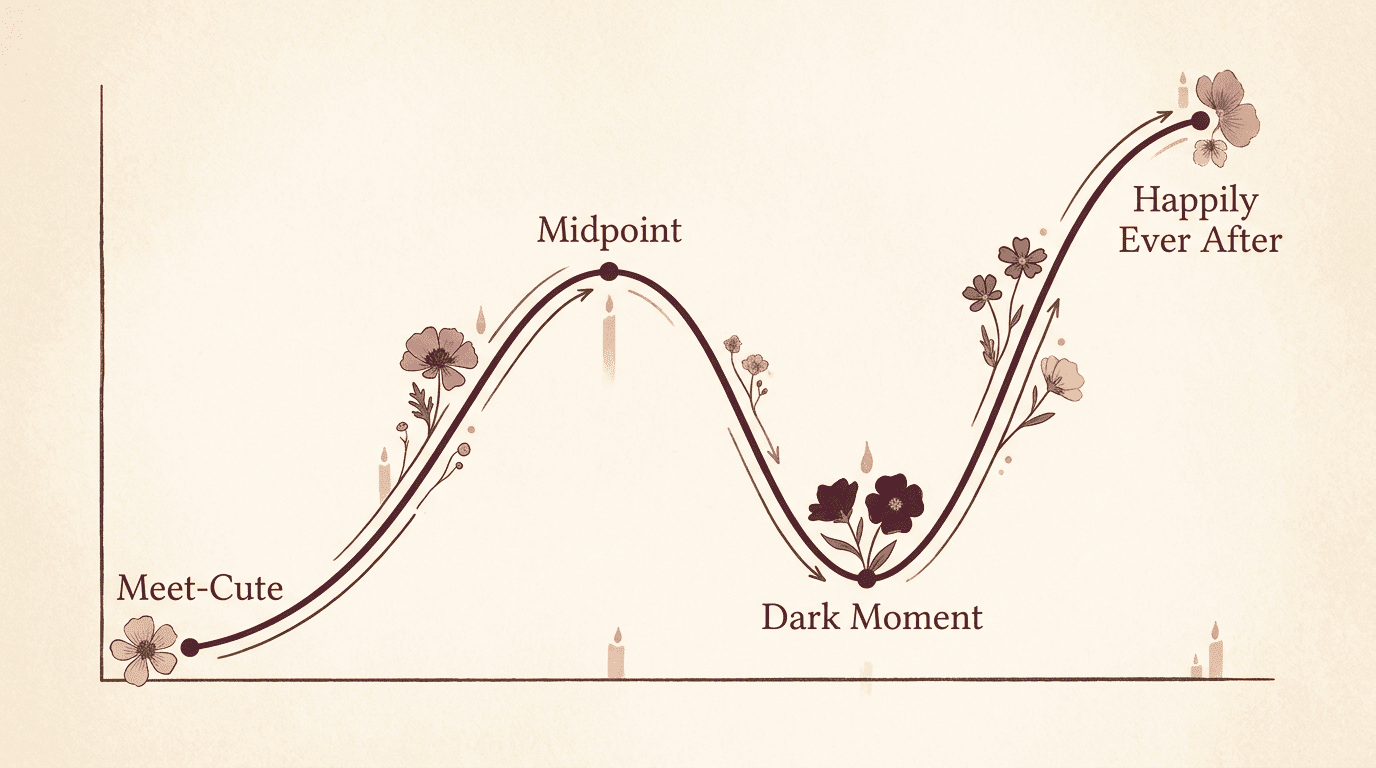
Beyond the plot outline, romance writers keep a relationship arc: where the two leads stand emotionally in each scene, what keeps them apart, and how trust builds scene by scene. Mapping this alongside the plot is especially useful for enemies-to-lovers or slow-burn stories, where the «plot» can look thin on paper even though the emotional tension is doing all the work. It’s also the natural place to plan a tasteful «fade to black» transition — implying intimacy rather than spelling it out — so the beat still lands without changing the register of the book.
| Romance beat | What happens | Typical placement |
|---|---|---|
| Meet-Cute | The leads’ first charged encounter | Opening pages |
| Adhesion | A reason forces them together despite resistance | End of Act 1 |
| Midpoint | First kiss or real emotional intimacy | Center of the book |
| Dark Moment | The relationship appears to collapse | Late Act 2 |
| Grand Gesture | One lead proves the relationship is worth the risk | Act 3 |
| HEA / HFN | The couple ends up together, happily or hopefully | Final pages |
Tools for Outlining: Index Cards, Software, and AI
Many novelists still swear by physical index cards or sticky notes on a trifold board or corkboard — one card per scene, easy to shuffle when the order isn’t working. It’s tactile, visual, and impossible to over-plan, which is exactly why Reedsy lists it as one of the most durable outlining habits among working authors.
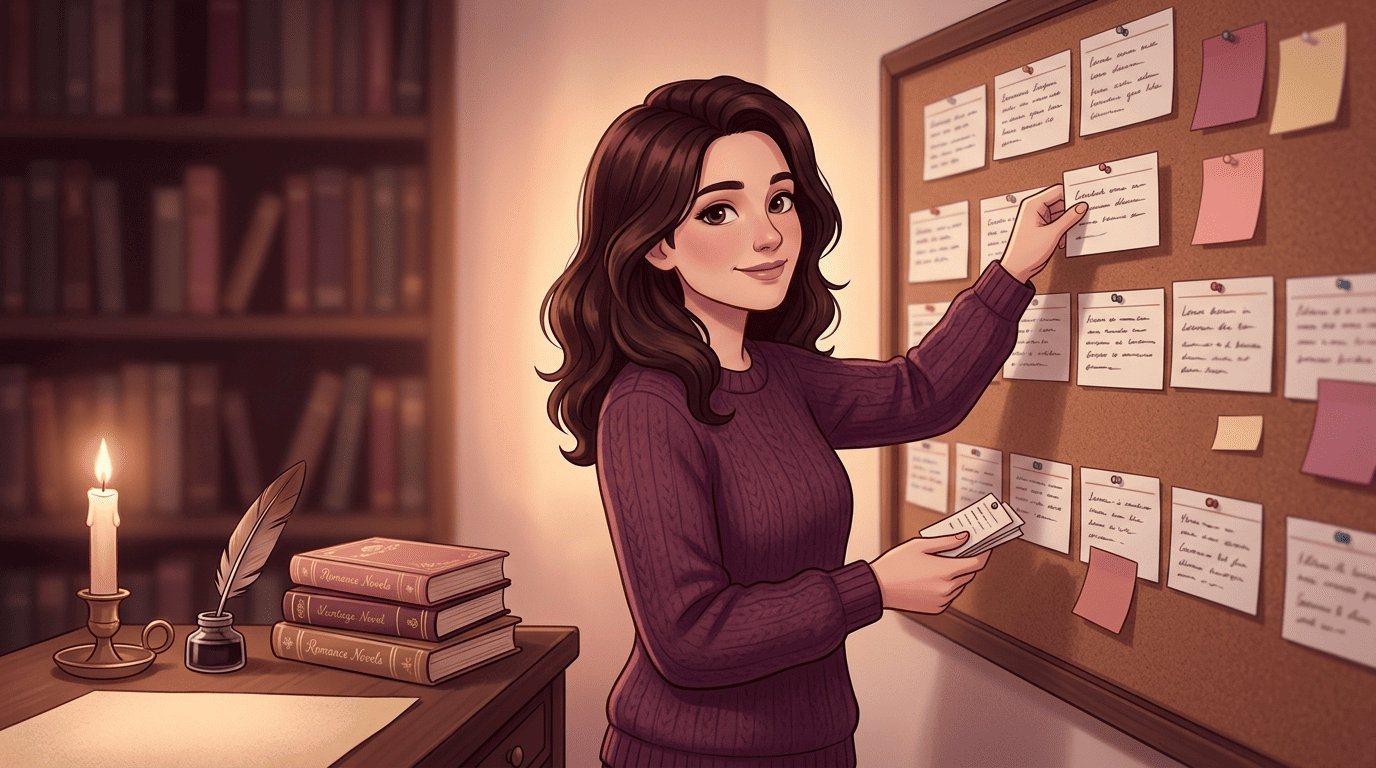
Digital tools like Scrivener and Reedsy Studio essentially digitize the corkboard, letting you drag scene cards around a virtual board instead of a physical one. Increasingly, writers pair these with a romance writing ai to pressure-test an outline — asking it to spot a saggy midpoint, suggest a stronger dark moment, or generate three alternate catalysts — before committing weeks to a full draft.
Whatever tool you pick, a few jobs stay constant across all of them:
- Holding the full scene order somewhere you can see it at a glance
- Making it easy to reorder scenes when the pacing feels off
- Tracking each scene’s point-of-view character and emotional goal
- Flagging gaps — a missing catalyst, a midpoint that never lands, a dark moment with no real stakes
How Detailed Should Your Outline Be?
A novel outline can be a single page or a 40-page bible — there’s no prize for detail. The one rule every source agrees on: don’t get married to it. As Jane Friedman’s contributors put it, the outline serves the story, not the other way around; when a better idea shows up mid-draft, follow it and revise the plan. Reedsy’s editors make the same point from the other direction — an outline can be as vague or as detailed as the individual writer prefers, as long as it does its job of keeping you moving forward.